Category:
What Is A Clean Break Order?
If you are divorcing, a clean break order permanently dismisses all future financial claims between you and your former spouse. In England and Wales, under section 25A of the Matrimonial Causes Act 1973 the court must consider whether a clean break can be achieved immediately or in the foreseeable future in every financial remedy case. The Ministry of Justice recorded 48,620 financial remedy cases starting in 2025, and a substantial share conclude with a clean break clause forming part of the final Consent Order. A clean break only closes financial claims between you and your former spouse; it never affects your child maintenance obligations.

Last reviewed: 17th August 2026
Article summary
✓ A clean break order dismisses all future financial claims between you and your former spouse, protecting you both from being pursued over income, property or capital acquired later in life.
✓ Section 25A of the Matrimonial Causes Act 1973 requires the court to consider whether a clean break is appropriate in every case, including yours.
✓ You can usually close capital claims like the family home, savings or pensions immediately, while spousal maintenance claims are sometimes kept open for a fixed term for example until minor children achieve a particular age.
✓ A clean break can often be achieved by one party paying an additional lump sum to buy out spousal maintenance and achieve an immediate clean break.
✓ Once a clean break order is sealed, you cannot normally reopen it, except in the rare circumstances recognised as a Barder event.
✓ A clean break has no effect on child maintenance, which remains a separate and ongoing obligation regardless of your financial settlement’s terms.
You assume that once your divorce goes through, the financial ties end with it. Unfortunately, this is not the case, at least not automatically. A couple divorcing after a short, childless marriage may find it relatively easy to agree to a clean break, with each keeping their own pension and splitting the sale proceeds of their flat. Contrast this with and a couple married for 20 years in a similar position where one spouse had given up their career to raise children and requires a period of spousal maintenance payments before any clean break could be deemed fair. As with every family law case, every outcome is different because no two families are alike.
Divorce ends your marriage, but it does not, by itself, end the financial relationship between you and your former spouse. Financial claims stay open indefinitely unless a specific order closes them, and that gap is exactly what a clean break order is designed to fill.
This article forms part of our wider guide to divorce and financial settlements
What does a clean break order actually do
A clean break order permanently ends your right, and your former spouse’s right, to bring a financial claim against the other’s income, capital, or pension in the future. Once sealed, neither of you can reopen the financial side of your marriage.
Section 25A of the Matrimonial Causes Act 1973 places a duty on the court to consider, in every case, whether it would be appropriate to exercise its powers so that your financial obligations towards each other are terminated as soon after your divorce order as the court considers just and reasonable. However, the court retains discretion and must consider all circumstances, including the financial needs and resources of the parties.
A clean break clause is included within a Consent Order alongside your substantive financial terms, rather than standing alone. Once approved, the clause protects you from being pursued years later if your income rises sharply, or if you acquire post separation savings or assets, and protects you equally if your former spouse remarries or their circumstances change.
A clean break covers capital and income claims between you and your former spouse, including claims against inheritance and future earnings. It has no bearing on your children: financial provision for a minor child continues under separate arrangements regardless of any clean break you agree between yourselves.
Is a clean break always achievable straight away?
A clean break is not always achievable straight away, and the court can order a deferred clean break if you genuinely need time to become financially independent. Claims on any capital can usually close immediately, even where maintenance cannot.
The House of Lords in Miller v Miller; McFarlane v McFarlane [2006] UKHL 24 recognised that an immediate clean break, while often the preferred outcome, is not always fair, particularly if you have suffered a lasting career disadvantage from time spent out of the workforce raising children. In cases like this, the court can order maintenance for a fixed term, deferring your clean break until that term ends rather than dismissing all claims on the day of the final order.
A deferred clean break fixes a specific date or event, such as your child finishing full-time education, after which your maintenance claim terminates permanently alongside any remaining capital claims. This structure gives you a defined timescale to retrain, return to work, or otherwise become self-sufficient, while still guaranteeing your former spouse an end date.
The Court can also make a spousal maintenance order extendable after the fixed term comes to an end if there is doubts about whether a clean break is achievable. For example, a court could order spousal maintenance until a child is 18 and has ceased full time secondary education but make the term extendable so that you could return to the court before the Order comes to an end if you need on-going spousal maintenance and a clean break is not appropriate.
The court may prioritise achieving a clean break through capital adjustments where possible so that a lump sum is paid to buy out on-going spousal maintenance payments and give the parties immediate financial independence. However, the court must ensure that such arrangements do not result in unfairness or undue hardship
Can a clean break order be reopened later?
You cannot normally reopen a clean break order once sealed by the court, except in the rare circumstances recognised as a Barder event, following Barder v Caluori [1988] AC. Courts treat finality as central to the purpose of a clean break.
A Barder event refers to a fundamental change in circumstances occurring shortly after your financial order is made, so significant that the change undermines the basis on which the order was reached. If you are seeking to set aside an order on this basis, you must show the new event was unforeseen, fundamentally invalidates the original assumptions, and that you applied without delay. Courts apply this test narrowly and grant it rarely, because you and your former spouse both need to be able to rely on the finality a clean break provides.
| Outcome | Finality for you | Can it be varied later |
| Immediate clean break | Complete on sealing | No, except in exceptional Barder circumstances |
| Deferred clean break | Complete once the fixed term ends | Maintenance can be varied before the term ends |
| Joint lives maintenance order | No clean break in place | Yes, on application to the court |
Talk to Purcell Solicitors
A clean break order is often used to bring ongoing spousal maintenance to a definite end, which is why couples exploring this option should speak to our spousal maintenance solicitors about whether it suits their circumstances. If you want certainty that your financial ties with your former spouse end when your divorce does, we can draft or negotiate the clean break clause your Consent Order needs. Our family law team drafts clean break clauses and Consent Orders across Milton Keynes, and you can reach us through our contact page.
Please note this article does not constitute legal advice.
For more information please see below.
Your Guide To Divorce Financial Settlements
Frequently asked questions
Does a clean break order cover child maintenance?
No, a clean break order never covers child maintenance, which remains a separate and ongoing obligation regardless of what you and your former spouse agree between yourselves. The Child Maintenance Service usually calculates child maintenance separately.
Can I get a clean break order without going to court?
Yes, you and your former spouse can agree the terms of a clean break through negotiation or mediation, but the clause only becomes legally binding once a judge seals it within a Consent Order. An informal agreement alone carries no legal force.
What happens if I do not get a clean break order?
Without a clean break order, you or your former spouse can bring a financial claim against the other’s income, capital, or pension at any point in the future, however many years have passed since your divorce. This risk exists even if you reached an informal understanding at the time.

Senior Family Law Partner & Director – SRA No. 258177
Pauline Purcell is the Managing Director and founder of Purcell Solicitors, a specialist family law firm based in Milton Keynes. She qualified as a solicitor and built her early career at Fennemores, a top-100 legal firm in central Milton Keynes, where she became a partner and head of the family department before establishing Purcell Solicitors in 2005.
She has specialised exclusively in family law for over 30 years. Her qualifications span several disciplines: she is a solicitor, a trained mediator, a collaborative lawyer, and a family arbitrator, and she was among the first collaborative lawyers in England. She holds a law degree from the University of Buckingham, where she also lectured on the part-time undergraduate law programme.
Chambers and Partners has ranked Pauline as a Band 1 practitioner for Family/Matrimonial in the Thames Valley for several years. The 2025 Chambers and Partners Guide describes her as “incredibly astute and excels at getting to the heart of the issue,” “robust and frighteningly clever,” and “a rock and massive support” to clients throughout their cases. She is also listed as a Leading Lawyer by Wiselaw.
Her particular expertise lies in high-value financial cases, including those involving business assets, pensions, and complex or international elements. She is a long-standing member of Resolution and is committed to reaching negotiated agreements wherever possible, though she regularly represents clients in court and family arbitration when proceedings become necessary.
Pauline is regulated by the Solicitors Regulation Authority (SRA number: 258177). She can be contacted at pauline@purcellsolicitors.co.uk.
How Are Pensions Divided In Divorce?
If you are divorcing, your pension can be divided by a pension sharing order, a pension attachment order, or offsetting against other assets. In England and Wales, this applies to divorcing and dissolving couples under the Welfare Reform and Pensions Act 1999. The Pension Advisory Group’s July 2019 guide to the treatment of pensions on divorce found pensions are often the second largest matrimonial asset after the family home yet remain the most frequently overlooked in negotiations. A pension can only be shared as part of a divorce or civil partnership dissolution, never through a private separation agreement alone.

Last reviewed: 17th August 2026
Article summary
✓ Your pension counts as a matrimonial asset under section 25 of the Matrimonial Causes Act 1973, whichever of you it is held in.
✓ A pension sharing order gives you a completely separate pension of your own, and this route achieves a clean break on that asset straight away. Some Government pension schemes require former spouses to remain as a member of that scheme, but under your own name.
✓ A pension attachment order keeps you financially tied to your former spouse for years and stops automatically if you remarry. Consideration also has to be given as to what happens to the pension if your former spouse dies and whether the pension dies with them
✓ Offsetting lets you trade pension value for other capital, often the family home or savings, if you need housing certainty now rather than retirement income later. A pensions on divorce expert will calculate the amount required to trade off.
✓ The transfer value your pension scheme quotes can significantly understate what a defined benefit pension is really worth, so skipping expert valuation risks a settlement that shortchanges you.
You may assume your pension is safely tucked away and separate from divorce financial proceedings. However, it is not. I recently advised a wife divorcing after a 19-year marriage who discovered that her husband’s NHS pension, valued on paper at £180,000, was worth considerably more to him at retirement than that headline figure suggested. If my client had relied on legal advice from ChatGPT and not acquired a proper pension valuation, she may have inadvertently accepted a settlement that dramatically understated her fair share of the couple’s true wealth. What is often important is how much income the value of the pension produces, not the value itself.
Pensions often don’t get the scrutiny the family home receives, despite frequently exceeding it in value. You have three ways to deal with a pension in your divorce financial settlement, namely:
- A pension sharing order,
- A pension attachment order, or
- Offsetting the pension against other assets
Picking the wrong solution can cost you far more than a badly negotiated house sale, so it is crucial to get advice from a solicitor experienced in pensions and divorce.
This article forms part of our wider guide to divorce and financial settlements. Let’s look at each option for dividing pensions on divorce in detail.
How does a pension sharing order work?
A pension sharing order transfers a fixed percentage of your spouse’s pension into an entirely separate pension in your own name. Once implemented, your pension operates completely independently of your former spouse’s.
Section 21A of the Matrimonial Causes Act 1973 defines a pension sharing order as one that provides for a party’s shareable rights under a pension arrangement to be subject to pension sharing for the benefit of the other party and specifies the percentage value to be transferred. If you receive a pension credit under this order, that credit becomes your own pension asset, and any contributions either of you make afterwards benefit only the person making them. Pension sharing orders are the most commonly used mechanism for dividing pensions because they give you a clean break on that specific asset, closing off any future dependence between you and your former spouse on that pension.
The court can only make a pension sharing order as part of your divorce or civil partnership dissolution proceedings. The order is not available if you separate but do not formally divorce, something you need to be aware of if you are not ready to completely end your marriage.
What is a pension attachment order?
A pension attachment order earmarks part of your former spouse’s pension for future payment to you once that pension comes into payment so that you receive the pension income directly from the pension company. The pension itself remains entirely in your former spouse’s name throughout.
Unlike a pension sharing order, an attachment order does not create a separate pension for you. The order instead directs the pension scheme to pay a defined portion of income, and sometimes a portion of any lump sum, directly to you. However, this arrangement carries real risk if you are the receiving spouse and your former spouse dies. The risk is that our pension payments stop automatically if your former spouse dies or if you remarry. This needs careful consideration and expert advice on how these risks could be mitigated.
Pension attachment orders are now comparatively rare in practice, precisely because they keep both of you financially connected for years after your divorce concludes. This route suits your situation only if sharing is not possible under the scheme rules (which is rare) or you specifically prefer ongoing income to an immediate transfer of pension.
What is pension offsetting?
Offsetting swaps a share of one spouse’s pension value for other capital, avoiding any pension order altogether. This route suits you if you strongly prefer to keep the family home rather than share a pension or to receive more capital and less pension.
Under offsetting, the spouse with the larger pension keeps it in full (or a larger share), while you receive a larger share of the other assets, typically the family home, to compensate. Offsetting requires careful legal advice because pension value and cash value are not equivalent pound for pound: tax usually applies to pension income on receipt, and you cannot access pension funds before a set age, so a straightforward one-for-one swap between pension value and property equity can leave you worse off in practice. This is a complex calculation which usually requires expert advice and a report from a pensions on divorce expert.
| Approach | What happens to the pension | Timing of benefit for you | Risk if you remarry |
| Pension sharing order | Split into two separate pensions | Immediate clean break | None, your pension is independent |
| Pension attachment order | Remains with original holder | Paid on retirement of holder | Your payments usually stop |
| Offsetting | Retained in full by one spouse | No pension order needed | Not applicable |
Why does pension valuation matter so much?
Pension valuation matters because the cash equivalent transfer value produced by the pension company t can significantly understate what a defined benefit pension is really worth to the member. This applies especially to NHS, teachers’, Police and Fire Officers, and other public sector schemes.
A cash equivalent transfer value, or CETV, is the figure your pension scheme calculates to represent the capital value of your benefits. For a defined contribution pension, this figure closely reflects the pension’s real worth, because the fund simply holds invested capital. For a defined benefit or final salary scheme, the CETV can be a poor guide to the pension’s true value, because the figure does not always reflect the guaranteed income the scheme promises to pay for life or annual automatic increases and other benefits such as former spouse death benefits.
The Pension Advisory Group’s July 2019 guide to the treatment of pensions on divorce recommends a pensions on divorce expert report wherever a defined benefit scheme is involved or the CETV exceeds £100,000. An actuary or pensions on divorce expert can produce a report comparing your pension’s income value to its transfer value, helping you and your former spouse agree a genuinely fair division rather than one based on a misleading headline figure.
For more information please see below.
Your Guide To Divorce Financial Settlements
Talk to Purcell Solicitors
Pension sharing is one of the most complex areas of a financial settlement, and our pensions and divorce solicitors regularly advise couples on the right approach for their retirement savings. If you need to work out what your pension is really worth or which division route suits your situation, we can guide you through the options and connect you with an actuary where you need one. Our family law team advises on pension sharing, attachment, and offsetting across Milton Keynes, and you can reach us through our contact page.
Please note this article does not constitute legal advice.
Frequently asked questions
Can my ex-spouse claim my pension years after we divorce?
Yes, your ex-spouse can bring a pension claim years after your divorce if no Consent Order or court order has closed off financial claims between you. Only a sealed order with a clean break clause prevents this.
Do I need an actuary to divide a pension in divorce?
Not always, but an actuary or pensions on divorce expert become important once a defined benefit scheme is involved or your pension’s CETV is large relative to your other assets. The transfer value alone can otherwise understate what the pension is really worth to you. We will advise you on whether you require an actuary or pensions on divorce expert report.
What happens to my pension if I remarry after a pension sharing order?
Nothing changes to a pension sharing order after you remarry, because the pension credit becomes your own separate asset at the point of the order. This differs from a pension attachment order, which usually stops if you remarry as the receiving spouse.
Senior Family Law Partner & Director – SRA No. 258177
Pauline Purcell is the Managing Director and founder of Purcell Solicitors, a specialist family law firm based in Milton Keynes. She qualified as a solicitor and built her early career at Fennemores, a top-100 legal firm in central Milton Keynes, where she became a partner and head of the family department before establishing Purcell Solicitors in 2005.
She has specialised exclusively in family law for over 30 years. Her qualifications span several disciplines: she is a solicitor, a trained mediator, a collaborative lawyer, and a family arbitrator, and she was among the first collaborative lawyers in England. She holds a law degree from the University of Buckingham, where she also lectured on the part-time undergraduate law programme.
Chambers and Partners has ranked Pauline as a Band 1 practitioner for Family/Matrimonial in the Thames Valley for several years. The 2025 Chambers and Partners Guide describes her as “incredibly astute and excels at getting to the heart of the issue,” “robust and frighteningly clever,” and “a rock and massive support” to clients throughout their cases. She is also listed as a Leading Lawyer by Wiselaw.
Her particular expertise lies in high-value financial cases, including those involving business assets, pensions, and complex or international elements. She is a long-standing member of Resolution and is committed to reaching negotiated agreements wherever possible, though she regularly represents clients in court and family arbitration when proceedings become necessary.
Pauline is regulated by the Solicitors Regulation Authority (SRA number: 258177). She can be contacted at pauline@purcellsolicitors.co.uk.
Your Guide To Divorce Financial Settlements
If you are divorcing, your money, property, and pensions do not divide themselves along with the marriage. In England and Wales, a financial settlement is a separate legal process, governed by section 25 of the Matrimonial Causes Act 1973, that decides who gets what and whether either of you pays ongoing maintenance. You can be legally divorced and still face a financial claim from your former spouse years later unless a court order closes that possibility for good.

Last reviewed: 17th August 2026
Article summary
✓ Your financial settlement is legally separate from your divorce. Getting divorced does not, by itself, stop your former spouse claiming against your income, property, savings or other assets, or pension later.
✓ The court divides your assets based on the factors under section 25 of the Matrimonial Causes Act 1973, which includes needs to achieve a fair outcome, not automatically down the middle.
✓ Your main options for reaching a settlement are direct negotiation, mediation, arbitration, or court proceedings, and most couples settle before a final hearing.
✓ Your pension is often your second largest asset after the family home, (and sometimes the largest asset) and dividing pensions correctly usually needs more than a quick look at the paperwork, and often specialist pensions on divorce reports.
✓ You only achieve finality once a judge seals a Consent Order, so an informal agreement between you and your former spouse may result in one party claiming against the other’s property, income, or assets in the future.
I recently advised a client getting divorced. They had already agreed, over a few informal coffees, to split everything fifty-fifty. After all, that was only fair, or so my client believed. However, after some careful valuations, he was horrified to discover that his wife’s pension was worth more than the house, their holiday home in Spain, and their combined savings. In addition, I had to inform him that although it was wonderful they were able to talk about their divorce financial settlement civilly and respectfully, their agreement was not legally binding, and neither of them had thought about what happens if one of them remarries or the other’s business suddenly takes off five years down the line.
The hardest aspects of divorce are reaching a financial settlement and making arrangements for your children. Although it may be tempting to try and use AI to work out these problems, chatbots cannot ask the right questions to uncover the true financial picture and apply the law to unique family situations and specifically to your own family situation. Getting early expert advice is essential if you want to ensure your financial settlement is fair.
What counts as a matrimonial asset?
Unless you have a pre or post nuptial agreement (and even then, these are not legally binding, although if they have been executed correctly the court will give them significant weight), almost everything you or your spouse built up during the marriage may count as a matrimonial asset, whoever’s name it sits in. Your family home, savings, pensions, business interests, and investments are all potentially part of the pot the court will look at.
Section 25 of the Matrimonial Causes Act 1973 directs the court to weigh all of your financial resources, not just the ones held jointly. Your family home counts as a matrimonial asset even if only one of you is on the title, because the property has usually housed the family throughout the marriage. Money you inherited or brought into the marriage can also be drawn into the matrimonial pot, particularly where your marriage has run for many years or you have mixed that money with joint finances.
The court does distinguish between matrimonial and non-matrimonial property. Non-matrimonial property, such as assets acquired before the marriage or through inheritance (if not mingled with other join assets), can be excluded from the sharing principle unless it has been “matrimonialised” through the parties’ treatment of the asset as shared over time. This concept was discussed in Standish v Standish [2025] UKSC 26, where the Supreme Court clarified that matrimonialisation depends on how the parties have dealt with the asset during the marriage. However, needs (particularly to be housed) will usually trump any argument that non matrimonial assets should not be shared with your spouse.
How does the court decide what is fair in a divorce financial settlement?
The court weighs the factors set out in section 25 of the Matrimonial Causes Act 1973, and no single factor decides your outcome on its own. These factors include:
✓ Resources available to both parties, both now and in the future.
✓ Length and duration of the marriage.
✓ Standard of living enjoyed by the parties.
✓ Contributions of each party (financial and non-financial).
✓ Conduct of the parties.
✓ Any benefits lost by either party as a result of the divorce.
The court gives first consideration to the welfare of any child of yours under 18. The House of Lords held in White v White [2000] UKHL 54 that there should be no discrimination between the roles of homemaker and breadwinner, and the “yardstick of equality” should be applied as a cross-check to ensure fairness. This principle is a cornerstone of financial remedy proceedings in England and Wales.
Can you keep the family home if you divorce?
The court’s decision on what happens to the family home depends on your and your children’s needs and what you can each afford, not on whose name is on the deeds. Ownership on paper matters far less here than most people expect.
If you have dependent children, the court may let the primary carer stay in the home if this is in their best interests, e.g. it would mean they do not have to change schools or move away from extended family. However, sometimes the family home must be sold so that both parties can be re-houses, particularly when care of children is shared as is often the case.
When it comes to dividing the family home, your options typically are a transfer into one of your names (purchasing the other’s interest), an immediate sale with proceeds split, or a deferred sale that keeps you in the home until a set event, such as your youngest child finishing school.
Although a deferred sale keeps you financially tied to your former spouse for longer, it is often necessary to achieve a fair settlement and ensure the best interests of your children. A clean break may be more desirable, but it is often not possible, and every family circumstance is unique. As a family law solicitor, my job is to advise you on the best options that puts your and your children’s needs first and protects your best interests.
Our guide on who gets the family home in a divorce takes you through each of these options and what they mean for your mortgage, your children’s stability, and your own finances.
What happens to your pension?
Your pension often turns out to be worth more than your house, yet pensions often get far less attention than property during a divorce. You can divide a pension through a pension sharing order, a pension attachment order, or by offsetting its value against other assets.
A pension sharing order transfers a set percentage of one pension into a brand new, separate pension in your name. A pension attachment order instead earmarks part of your former spouse’s pension for you once it comes into payment, but that arrangement ends automatically if you remarry and keeps you financially connected to your former spouse for years. Pension earmarking is rare given this disadvantage and pension sharing is usually the best option. Offsetting swaps your share of a pension for other capital, often a bigger share of the family home, which suits you if you need housing certainty now rather than income decades from now.
The cash equivalent transfer value used to value most pensions can understate what a defined benefit pension, such as an NHS or teacher’s pension, is worth to the person who holds it. Where a defined benefit scheme is involved, or the pension values are large relative to your other assets, an independent pensions on divorce expert can produce a report showing what the pension is really worth to you or your spouse, not just its transfer value on paper and what share of the pension needs to be transferred to achieve equality of income based on the current pension values. Our guide on how pensions are divided in divorce sets out each option in more depth.
| Option | What happens to the pension | Best for you if |
| Pension sharing order | Splits into two separate pensions | You want a clean break on this asset now |
| Pension attachment order | Stays with the original holder, paid to you later | Sharing is not possible under the scheme rules |
| Offsetting | Retained in full by one spouse | You need housing certainty rather than future income |
What are your options if you cannot agree on the divorce financial settlement?
If you and your former spouse cannot agree, you still have several routes before court becomes necessary, and most couples settle without a contested hearing.
✓ Mediation puts you and your former spouse in a room with an independent, trained mediator who helps you reach your own agreement rather than deciding for you.
✓ Arbitration you both appoint and pay an arbitrator whose decision becomes legally binding once you have agreed to be bound by it.
✓ A private Financial Dispute Resolution hearing puts your case in front of an experienced lawyer or retired judge who gives you a frank, non-binding view of what a court is likely to decide, which often prompts settlement on the spot. These are becoming an increasingly popular way of resolving disputes.
Rule 3.3 of the Family Procedure Rules 2010 requires the court to consider, at every stage of your case, whether non-court dispute resolution is appropriate for you. If you refuse to engage with these options without good reason, you risk a costs penalty later, so weighing them carefully is worthwhile even if court still feels like the safer option right now.
How do you make the divorce financial settlement final?
You make your settlement final by asking a judge to seal a Consent Order, the document that turns your agreement into a legally binding, enforceable court order. Without one, any agreement you reach, however detailed, carries no legal force, and either of you can bring a fresh financial claim later.
Applying for a Consent Order means you both sign the draft order, complete a Statement of Information on Form D81 setting out your finances, and submit these alongside the correct court fee. A judge reviews every Consent Order to check the terms are fair before sealing it, and you will not usually need a hearing for this step.
A Consent Order can include the transfer or sale of your home, lump sum payments, a pension sharing order, spousal maintenance, and a clean break clause that dismisses future claims between you. Once sealed, capital provisions like a property transfer cannot normally be changed, though spousal maintenance can be varied later if your circumstances shift substantially.
What does a clean break mean?
A clean break gives you a permanent end to financial claims between you and your former spouse, so neither of you can come back later for a share of income, savings, or a pension you build up afterwards. Section 25A of the Matrimonial Causes Act 1973 requires the court to consider a clean break in every case.
You can usually achieve an immediate clean break on capital matters like the family home, even where spousal maintenance needs to run for a fixed period first. If you gave up a career to raise children, the court may order spousal maintenance for a set number of years before the clean break takes effect, giving you time to become financially independent. Once sealed, a clean break order is very difficult to reopen, so getting the terms right the first time matters more than reaching a quick agreement under pressure.
Talk to Purcell Solicitors
If you are approaching this stage of your divorce, our divorce financial settlement solicitors can talk you through how the process is likely to unfold in your own circumstances. We can explain your options and what each one means for your situation. Our family law team has negotiated settlements across Milton Keynes, Bedfordshire, Northamptonshire, and the Thames Valley for over 20 years, and you can reach us through our contact page.
Please note this article does not constitute legal advice.
Further Guides
Divorce Financial Settlement Process Guide
How Are Pensions Divided In Divorce?
Frequently asked questions
Can my former spouse claim my pension years after we divorce?
Yes, your former spouse can bring a pension claim years after your divorce if no Consent Order has closed off financial claims between you. Only a sealed order with a clean break clause protects you from this.
Do I need a solicitor if we have already agreed everything?
You do not strictly need a solicitor to negotiate terms, but you do need a Consent Order sealed by the court to make your agreement legally binding. Many people ask us to draft that order even after agreeing the substance themselves.
How long will my financial settlement take?
Your financial settlement typically takes two to four months to finalise once you agree the terms, or nine to eighteen months if your case is contested and needs a court hearing. Complex cases involving businesses or pensions can take longer.
What happens if we cannot agree and go to court?
If you and your former spouse cannot agree, the court will decide your financial settlement for you after considering the section 25 factors. Most cases still settle before a final hearing, often at a Financial Dispute Resolution hearing along the way which can take place in Court, or you could agree to have a private FDR which is considerably quicker.
Senior Family Law Partner & Director – SRA No. 258177
Pauline Purcell is the Managing Director and founder of Purcell Solicitors, a specialist family law firm based in Milton Keynes. She qualified as a solicitor and built her early career at Fennemores, a top-100 legal firm in central Milton Keynes, where she became a partner and head of the family department before establishing Purcell Solicitors in 2005.
She has specialised exclusively in family law for over 30 years. Her qualifications span several disciplines: she is a solicitor, a trained mediator, a collaborative lawyer, and a family arbitrator, and she was among the first collaborative lawyers in England. She holds a law degree from the University of Buckingham, where she also lectured on the part-time undergraduate law programme.
Chambers and Partners has ranked Pauline as a Band 1 practitioner for Family/Matrimonial in the Thames Valley for several years. The 2025 Chambers and Partners Guide describes her as “incredibly astute and excels at getting to the heart of the issue,” “robust and frighteningly clever,” and “a rock and massive support” to clients throughout their cases. She is also listed as a Leading Lawyer by Wiselaw.
Her particular expertise lies in high-value financial cases, including those involving business assets, pensions, and complex or international elements. She is a long-standing member of Resolution and is committed to reaching negotiated agreements wherever possible, though she regularly represents clients in court and family arbitration when proceedings become necessary.
Pauline is regulated by the Solicitors Regulation Authority (SRA number: 258177). She can be contacted at pauline@purcellsolicitors.co.uk.
Private Financial Dispute Resolution Hearings
If you and your former spouse are struggling to agree a financial settlement, a private Financial Dispute Resolution hearing can be agreed to take place to try to resolve the dispute. An independent evaluator (usually a barrister, senior solicitor, or retired Judge) gives a non-binding indication of how they would decide the case and what a court is likely to order. In England and Wales, this process mirrors the court-based FDR appointment under rule 9.17 of the Family Procedure Rules 2010 but takes place at a time and location you choose before a private Judge. One provider’s data shows private FDR achieves a settlement rate of around 80%, compared with under 50% for the court-based equivalent, according to the Farquhar Report. You do not need a court order permitting you to use a private FDR and can agree to have a private FDR without any Court proceedings being issued. If you are within existing Court proceedings, you can agree to postpone those to enable you to attend a private FDR.

Last reviewed: 27th July 2026
Article summary
✓ Your private FDR hearing gives you a non-binding indication from an independent evaluator about how a court would likely decide your case.
✓ You and your former spouse jointly choose and pay the evaluator, often a senior barrister or a retired judge, and agree a date that suits you both for the hearing to take place.
✓ The evaluators costs are typically between £3,000 to £6,000 plus vat usually split between you, plus your own legal representation.
✓ If you are already in existing Court proceedings and rely on the court’s own FDR listing, you risk waiting significantly longer for a private FDR hearing and risk a lower chance of settling on the day, given current court delays.
Introduction
It is no secret that the family court system in England and Wales is creaking at the seams. Financial remedy proceedings currently take an average of nine to 18 months from filing the initial application (Form A) to securing a final order. However, due to a shortage of judges, hearings are often cancelled at the last minute and proceedings delayed for long periods, This can be extremely stressful and frustrating for couples who want to move forward with their post-divorce lives. One way to avoid these delays is to have a private Financial Disputes Resolution (FDR) hearing. This gives you and your former spouse the same kind of judicial steer, on a date you choose, without waiting in a queue.
If you are not already within Court proceedings for financial remedy you can both agree to appoint a private FDR judge to give guidance and their view on likely outcomes if the matter were to proceed to Court. Many couples are using the private FDR process to settle financial matters on divorce quickly and cost effectively without involving the Court.
What is a Private Financial Dispute Resolution hearing?
A private Financial Dispute Resolution (FDR) hearing, also referred to as a private early neutral evaluation (ENE), is an alternative to the court-based FDR process in financial remedy proceedings. It involves the parties voluntarily engaging a neutral third party, often a specialist barrister, solicitor, or retired judge, to facilitate negotiations and provide an evaluative opinion on the likely outcome of the case. This process is designed to assist the parties in narrowing or resolving their financial disputes on the day without the need for a court hearing.
Private FDRs offer several advantages over court-based financial dispute resolution hearings. They allow for greater flexibility in scheduling, as the parties can choose a time and location that suits them, including evenings or weekends. The evaluator is a specialist in the area to be resolved which is particularly helpful in complex financial matters. The evaluator also t has much more time to prepare and focus on the case, receiving and reading the papers in advance which often a Court Judge does not have time for., This leads to a higher chance of settling on that day or shortly thereafter. The costs of the evaluator are borne by the parties, usually shared equally, although one party may agree to cover the full cost
What happens on the day of a private FDR hearing?
On the day of your private FDR, the independent evaluator that you and your former spouse have jointly appointed reads your papers in advance, hears submissions from the legal representatives of each side, then gives their view of how the issues should be settled and the likely outcome at a final hearing. You typically spend the morning before the evaluator who gives their indication and then the rest of the day negotiating to try to resolve all issues. If you are able to reach an agreement a Consent Order setting out the terms of the agreement is prepared and signed by all parties so you can finalise the day knowing you have concluded all matters. This is an enormous relief for most people that they have been able to resolve all matters. The Consent Order will then be lodged at Court for approval and made into a formal Court Order.
Your private FDR follows the same structure as the court-based FDR appointment under rule 9.17 of the Family Procedure Rules 2010. Rule 9.17(1) states that “the FDR appointment must be treated as a meeting held for the purposes of discussion and negotiation,” and rule 9.17(6) requires that “parties attending the FDR appointment must use their best endeavours to reach agreement on matters in issue between them.” For your private hearing, which means the day is built around settlement, not around a formal legal argument. The whole session is conducted on a without prejudice basis, meaning that discussions and proposals made during the session cannot be used as evidence in subsequent court proceedings if you have been unable to reach an agreement.
You and your former spouse each attend with your own legal representative, and the evaluator hears brief submissions on the outstanding issues before giving an indication of their give and what a court would likely order. This can often be a range of potential outcomes given the discretionary nature of a judge imposed decision at a final hearing.
Who acts as the evaluator?
The evaluator acting is usually a senior family barrister or solicitor or a retired family court judge, chosen jointly by you and your spouse rather than assigned by the court.
You have freedom to select someone whose experience matches your case, whether that means a solicitor or barrister who has extensive experience in divorce financial settlements or a retired judge with decades of financial remedy experience on the bench. Because you are both paying for this person’s time, you can choose someone whose availability suits your timetable, rather than accepting whichever judge happens to be free on the court’s list that day. Your evaluator’s role ends once the hearing concludes and they take no further part in your case if it proceeds to a formal court hearing.
How much does a private FDR cost?
A private FDR evaluator’s fee typically ranges from £3,000 to £6,000 plus vat for the day, split between you and your spouse (although one party can pay the entire fee if that is what you both agree), on top of your own legal representation costs. Complex cases involving business valuations or offshore assets can push the evaluator’s fee higher.
Private FDR costs include the evaluator’s preparation time reading your papers in advance (often the day before), plus their attendance for the full day. Where the hearing takes place at solicitors’ or barrister’s offices, this fee often also covers room hire and refreshments. Your own barrister or solicitor’s fees for preparing and attending the hearing sit on top of the evaluator’s charge, much as they would for a court FDR. Weighed against the cost of a contested final hearing, which can run into many thousands of pounds once expert witnesses and multiple further hearings are added, a private FDR often represents the cheaper route to a resolved case.
How likely is a private FDR to settle your case
A private FDR settles the large majority of cases that use it, with one specialist provider reporting an 80% success rate compared with under 50% for court-based FDR hearings, according to the Farquhar Report. The idea of private FDRs also has enthusiastic support from the judiciary. On his last day in office as President of the Family Division (27 July 2018), Sir James Munby expressed his support, saying:
“I hope that the lead and other judges will take the opportunity to develop and encourage the use of ‘private’ FDRs locally. A private FDR is a simple concept. The parties pay for a financial remedy specialist to act as a private FDR judge. That person may be a solicitor, barrister, or retired judge. No additional qualifications are required. The private FDR takes place at a time convenient to the parties, usually in solicitors’ offices or barristers’ chambers, and a full day is normally set aside to maximise the prospects of settlement. It takes the place of the in-court FDR.”
The higher settlement rate reflects the focused attention a private FDR gives your case: your evaluator has read only your papers, has an entire day set aside for you, and faces none of the list pressure a court-based FDR judge often does. If you do not settle on the day, you have lost nothing procedurally if you are already within existing Court proceedings: the case simply continues towards a final hearing, with directions given by the court in the usual way. Most couples find that even where full agreement is not reached at the hearing itself, the evaluator’s indication substantially narrows what remains in dispute.
Private FDRs are particularly useful and successful if you are not already within existing Court proceedings but wish to try to resolve all financial matters at an early stage without the Court’s involvement and delays. You and your solicitors can agree to appoint a private FDR Judge early on, after financial disclosure has taken place and thus avoid what are often substantial delays and costs in going through the Court process.
When is a private FDR suitable for your case
A private FDR suits your case if you and your former spouse are both willing to engage constructively, your assets are complex enough to benefit from focused expert attention, or you want a faster resolution than the current court list allows. It requires genuine cooperation from both sides to work.
You can use a private FDR either within existing court proceedings, once the court grants an order permitting the substitution, or before you have issued a court application at all, provided you have exchanged financial disclosure voluntarily. This flexibility means you do not have to wait until your case reaches the court’s own FDR stage to try this route. A private FDR is less likely to help you if your former spouse is unwilling to negotiate in good faith, since the entire process depends on both of you using the evaluator’s indication as a genuine basis for settlement rather than as another point to dispute.
Our guide on which non-court dispute resolution route to use compares a private FDR against mediation, arbitration, and collaborative law, so you can weigh which option fits your situation before committing to one.
Talk to Purcell Solicitors
A private FDR is just one of several non-court dispute resolution options available to separating couples, and our non-court dispute resolution team can help you decide which route best suits your situation. We have considerable experience in private FDR’s and regularly act for clients as their Solicitor in a private FDR, either within existing Court proceedings or before any Court proceedings are issued. We are also able to advise you strategically as to whether it is in your interests to have a private FDR, and when, to maximise your chances of success and be as cost effective as possible.
If you are considering a private FDR or want help choosing the right evaluator for your case, we can talk you through the process and what it is likely to cost you. Our family law team regularly represents clients at private FDR hearings across Milton Keynes, Bedfordshire, Northamptonshire, Cambridgeshire, Hertfordshire and the Thames Valley, and you can reach us through our contact page.
Please note this article does not constitute legal advice.
Frequently Asked Questions
Is the outcome of a private FDR legally binding?
No, the evaluator’s indication at a private FDR is not legally binding, and either you or your former spouse remains free to reject it and proceed to a final hearing. If you do reach agreement, it becomes binding only once drafted into a consent order and sealed by the court.
Can we use a private FDR if court proceedings have not started?
Yes, you can use a private FDR before issuing a court application, provided you and your former spouse have voluntarily exchanged financial disclosure first. Many couples choose this route specifically to resolve matters before court costs begin building up.
What happens if we do not settle at the private FDR?
If you do not settle at your private FDR, your case simply continues through the normal court process towards a final hearing, exactly as it would after an unsuccessful court-based FDR. Nothing discussed at your private FDR can be used against you later, since the hearing is conducted on a without prejudice basis.
Senior Family Law Partner & Director – SRA No. 258177
Pauline Purcell is the Managing Director and founder of Purcell Solicitors, a specialist family law firm based in Milton Keynes. She qualified as a solicitor and built her early career at Fennemores, a top-100 legal firm in central Milton Keynes, where she became a partner and head of the family department before establishing Purcell Solicitors in 2005.
She has specialised exclusively in family law for over 30 years. Her qualifications span several disciplines: she is a solicitor, a trained mediator, a collaborative lawyer, and a family arbitrator, and she was among the first collaborative lawyers in England. She holds a law degree from the University of Buckingham, where she also lectured on the part-time undergraduate law programme.
Chambers and Partners has ranked Pauline as a Band 1 practitioner for Family/Matrimonial in the Thames Valley for several years. The 2025 Chambers and Partners Guide describes her as “incredibly astute and excels at getting to the heart of the issue,” “robust and frighteningly clever,” and “a rock and massive support” to clients throughout their cases. She is also listed as a Leading Lawyer by Wiselaw.
Her particular expertise lies in high-value financial cases, including those involving business assets, pensions, and complex or international elements. She is a long-standing member of Resolution and is committed to reaching negotiated agreements wherever possible, though she regularly represents clients in court and family arbitration when proceedings become necessary.
Pauline is regulated by the Solicitors Regulation Authority (SRA number: 258177). She can be contacted at pauline@purcellsolicitors.co.uk.
What Is Family Law Arbitration?
If you and your former partner cannot agree a financial settlement or children’s arrangement, family law arbitration gives you a private way to get a binding decision without waiting for a court date. In England and Wales, the process runs under the Institute of Family Law Arbitrators Scheme and the Arbitration Act 1996, so you can choose a qualified arbitrator, set a timetable that fits your case, and keep the dispute out of the public courtroom.

Last reviewed: 28th July 2026
Article summary
✓ Family law arbitration gives you a binding decision from an arbitrator you and your former partner choose.
✓ You can use arbitration for financial disputes on divorce and for specified disputes about your children, including where they live and how time is shared.
✓ The arbitrator is specifically experienced in the area of law to be determined which can be particularly helpful in complex matters.
✓ Pauline Purcell is an IFLA-accredited family arbitrator in financial remedy cases, so you can ask her to act as arbitrator or to represent you in an arbitration where another arbitrator is appointed.
✓ Your hearing takes place in private, with no media access and no public record of the arbitration itself.
✓ If you wait for a court hearing instead, you may face months, and sometimes years, of delay that arbitration can often avoid.
Introduction
In my experience, most clients are highly distressed if mediation or other forms of non-court dispute resolution fail as they assume the next step is a contested court hearing, with all the stress and cost such a route involves. Fortunately, there is an alternative solution. Family law arbitration allows you and your former partner/spouse to appoint an experienced qualified arbitrator, fix a timetable around your case, and move to a binding outcome (the courts retain jurisdiction to uphold or enforce the award, ensuring it aligns with legal standards) without joining the court backlog. In addition, the cost of family law arbitration is usually less than taking your case to the Family Court.
What is family law arbitration?
Family law arbitration is a private and formal method of dispute resolution where parties agree to appoint an experienced qualified arbitrator to adjudicate their dispute and make a binding decision. It has been available in England and Wales since 26 March 2012
Family arbitration can address financial disputes arising from marriage, civil partnerships, cohabitation, and parenting arrangements, as well as disputes concerning children. The process is initiated by the parties signing an arbitration agreement, such as the ARB1FS form for financial disputes or the ARB1CS form for children disputes, which binds them to the arbitration process and the Institute of Family Law Arbitrators IFLA rules. The arbitrator’s decision, referred to as an award (in financial cases) or a determination (in children’s cases), is binding on the parties, provided it falls within the parameters that a court would consider acceptable.
How does arbitration differ from mediation?
Arbitration gives you a binding decision from a qualified arbitrator. Mediation helps you and your former partner try to reach your own agreement, but the mediator cannot impose an outcome. If mediation breaks down, arbitration gives you a route to a decision that does not depend on further agreement between you.
In mediation, a trained mediator helps you discuss the issues, but any arrangement you reach usually needs to be turned into a court order by consent before it carries legal effect. In arbitration, by signing the aforementioned forms, you and your partner agree to be bound by the arbitrator’s written decision under the IFLA rules. The arbitrator then makes a decision which is usually binding on the parties and unless there are exceptional circumstances, approved by the Court and made into a Court Order.
Who can act as your arbitrator?
Your arbitrator must be a family law specialist accredited under the IFLA scheme. That will usually be an experienced solicitor, barrister, or retired judge with arbitration training and qualifications. You and your former partner must agree who that person is, and you can choose an arbitrator with specific experience in the area of law which needs to be resolved. This can be in contrast with a Court Judge who may have their core experience in another area of law.
I am accredited by IFLA as an arbitrator whose specialism includes family financial matters, particularly those involving pensions or businesses. You can ask me to act as arbitrator if both of you agree, or I can represent you as your Solicitor in an arbitration conducted by another arbitrator.
Once appointed, your arbitrator only decides the dispute you have referred to arbitration. Article 2 of the Family Law Arbitration Scheme Rules sets out the financial and property disputes the scheme can cover, so the arbitrator’s authority depends on the issues you and your former partner have agreed to submit.
Can arbitration resolve disputes about my children?
Yes. If you and your former partner both agree, arbitration can resolve some disputes about your children as well as financial disputes. Although, arbitration concerning children’s issues is limited in its scope an arbitrator can make decisions about numerous issues concerning your children. .
The IFLA Children Arbitration Scheme allows parties to resolve private law disputes concerning children, provided they fall within the scheme’s remit. These include issues such as:
✓ where a child should live,
✓ shared living arrangements,
✓ visiting arrangements,
✓ education,
✓ routines,
✓ non-life-threatening medical treatment, and
✓ applications to remove a child from the jurisdiction temporarily or permanently.
However, the scheme expressly excludes certain matters, such as:
✓ international child abduction cases,
✓ disputes involving the jurisdiction of courts outside England and Wales,
✓ life-changing or life-threatening medical treatment, and
✓ cases where a party lacks capacity under the Mental Capacity Act 2005.
How much faster and more private is arbitration?
Arbitration can move much faster than a contested court hearing because the timetable is fixed around the arbitrator’s availability and your case, rather than the court’s listing pressures. The family courts are under significant pressure and private law cases, particularly financial remedy on divorce can be significantly delayed in the Court system as other areas of law are given priority to Court resources. Under the IFLA rules, the arbitration and its outcome are confidential except where disclosure is needed to challenge, implement, enforce, or vary an award, or where the law requires disclosure.
The arbitrator will control the process and make directions about what financial disclosure must be provided before a decision can be made. IFLA’s public guidance states that media are not admitted to meetings, so your finances and your children’s arrangements stay out of a public hearing list.
| Feature | Family arbitration | Contested court hearing |
| Who decides | An arbitrator you and your former partner choose | A judge assigned by the court |
| Timetable | Fixed around availability in your case | Fixed by the court listing system |
| Privacy | Confidential process; media not admitted to meetings | Court hearings may be open to the public and press |
| Typical pace | Often much quicker than waiting for a final hearing date | Often slowed by court delay and adjournment risk |
Is a family law arbitrator’s decision legally binding?
Your arbitrator’s decision is intended to be binding once you and your former partner have signed the arbitration agreement., In financial cases, although a properly conducted arbitral award carries substantial weight, the court must still assess the award against the factors listed in section 25 of the Matrimonial Causes Act 1973 and determine if the financial settlement is fair and puts the welfare of any children first and foremost. The court retains the discretion to substitute its own order if it finds the award to be unjust or outside the range of reasonable outcomes. However, it is rare for a Court to overturn an arbitrator’s award.
Talk to Purcell Solicitors
If you are considering family law arbitration, we can talk you through how the process works, whether it suits your case, and what the next step would look like. We advise on arbitration across Milton Keynes, Bedfordshire, Northamptonshire, Hertfordshire, Cambridgeshire and the Thames Valley. You can contact us through our contact page or by telephone on 01908 693000.
Please note this article does not constitute legal advice.
Frequently Asked Questions
Do I have to go to arbitration?
No. Arbitration is voluntary. It only goes ahead if you and your former partner both agree and sign the relevant arbitration form. If one of you does not agree, you will need to use negotiation, mediation, or court instead.
Can I challenge the award?
You can challenge an award, but only on very limited grounds. Those grounds include a point of law, lack of jurisdiction, or serious procedural irregularity. Disagreeing with the result on its own will not be enough.
Does arbitration cost more than court?
You do pay the arbitrator’s fees directly, which you would not do with a Court judge. Even so, arbitration can reduce the overall cost of the dispute if it narrows the issues, shortens the timetable, and avoids repeated court hearings. The usual position under the IFLA rules is that you share the arbitrator’s fees equally and each of you pays your own legal costs unless conduct justifies a different costs order. You can agree that one party pays the arbitrator’s costs.
Senior Family Law Partner & Director – SRA No. 258177
Pauline Purcell is the Managing Director and founder of Purcell Solicitors, a specialist family law firm based in Milton Keynes. She qualified as a solicitor and built her early career at Fennemores, a top-100 legal firm in central Milton Keynes, where she became a partner and head of the family department before establishing Purcell Solicitors in 2005.
She has specialised exclusively in family law for over 30 years. Her qualifications span several disciplines: she is a solicitor, a trained mediator, a collaborative lawyer, and a family arbitrator, and she was among the first collaborative lawyers in England. She holds a law degree from the University of Buckingham, where she also lectured on the part-time undergraduate law programme.
Chambers and Partners has ranked Pauline as a Band 1 practitioner for Family/Matrimonial in the Thames Valley for several years. The 2025 Chambers and Partners Guide describes her as “incredibly astute and excels at getting to the heart of the issue,” “robust and frighteningly clever,” and “a rock and massive support” to clients throughout their cases. She is also listed as a Leading Lawyer by Wiselaw.
Her particular expertise lies in high-value financial cases, including those involving business assets, pensions, and complex or international elements. She is a long-standing member of Resolution and is committed to reaching negotiated agreements wherever possible, though she regularly represents clients in court and family arbitration when proceedings become necessary.
Pauline is regulated by the Solicitors Regulation Authority (SRA number: 258177). She can be contacted at pauline@purcellsolicitors.co.uk.
Financial Remedies Reform Explained
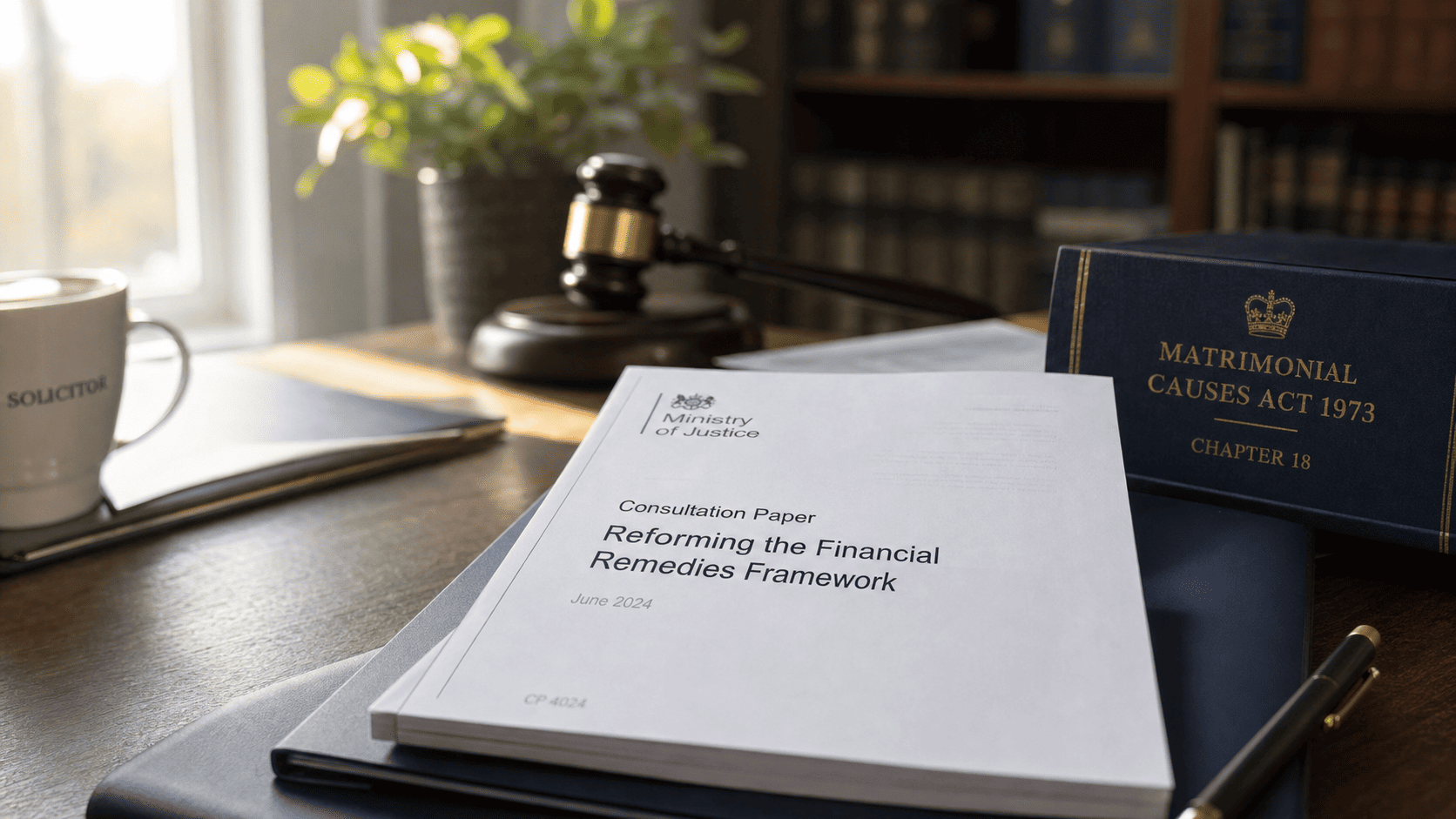
A new Government consultation, entitled A Fairer End to Relationships, proposes bringing settled case law into statute and introducing binding qualifying nuptial agreements. In England and Wales, the current law under section 25 of the Matrimonial Causes Act 1973 gives judges wide discretion, which the Law Commission’s December 2024 scoping report found creates uncertainty rather than settled expectations. Nothing changes for your case today since the consultation closes on 14th August 2026 and any resulting legislation is not expected before 2027 or 2028 at the earliest.
Last reviewed: 21st July 2026
Article summary
✓ The Law Commission concluded in December 2024 that the law lacks the certainty and accessibility that couples need when negotiating a divorce financial settlement.
✓ The government’s preferred model, called codification-plus, would set today’s case law principles into statute while making targeted changes in areas like nuptial agreements.
✓ If you want financial certainty now, a pre-nuptial or post-nuptial agreement, drafted properly, already carries significant weight under existing law.
✓ Non-court dispute resolution remains the fastest route to a settlement for you right now, whatever reforms eventually follow.
Introduction
The rules governing divorce financial settlements are currently well understood, however the Matrimonial Causes Act 1973 has not been substantively rewritten in over fifty years. Marriage and families have changed a great deal over this time. That’s why, on 5th June 2026 the government launched a consultation, A Fairer End to Relationships. If the proposals are passed into law, it would signify the biggest change to divorce finance law in England and Wales in decades.
At the centre of the proposals is a ‘codification-plus’ model, which would put settled case-law principles, such as sharing and needs, into statute for the first time, while keeping a degree of judicial discretion within a clearer framework. The consultation also asks whether legally binding ‘qualifying nuptial agreements’ should be introduced, giving couples more certainty over how their finances would be divided if they later divorced, provided safeguards such as full financial disclosure and independent legal advice are met.
None of the above impact your position if you are going through a divorce today. The consultation closes on 14th August 2026, and any reform will still need further policy development and a new Act of Parliament before it becomes law, so it will not affect cases already before the courts.
Why is the current law considered uncertain?
The current law gives judges very wide discretion under section 25 of the Matrimonial Causes Act 1973, and neither ‘financial needs’ nor ‘matrimonial property’ is defined anywhere in the statute itself. Two judges can reach different outcomes on similar facts, making it hard for you to predict your own case.
The
What is the Law Commission’s position?
The Law Commission concluded in its December 2024 scoping report that the law around divorce financial settlements requires reform but left the choice of model to government rather than making a specific recommendation itself. It set out four broad possible approaches, from a straightforward restatement of existing case law to a wholly new default matrimonial property regime. These ranged from:
✓ Codification – which restates current case law with minimal change.
✓ Codification-plus – which restates the law but makes targeted reforms in areas like nuptial agreements.
✓ Guided judicial discretion.
✓ A default regime – resembling frameworks used elsewhere in Europe.
The government has since chosen codification-plus as its preferred model, confirming its June 2026 consultation document would bring ‘settled case law principles, such as those of needs and sharing, into statutory form,’ according to the official consultation document.
What is proposed for nuptial agreements
The consultation proposes introducing binding qualifying nuptial agreements, which would let you and your partner make financial arrangements in advance that a court must uphold, subject to specific safeguards. This would go further than the current law, where nuptial agreements carry significant weight but are never fully binding on the court.
Under the current law, the Supreme Court held in Radmacher v Granatino [2010] UKSC 42, at paragraph 75, that:
“The court should give effect to a nuptial agreement that is freely entered into by each party with a full appreciation of its implications unless in the circumstances prevailing it would not be fair to hold the parties to their agreement.”
For you, that means a well-drafted agreement already carries real weight today, even though the court remains, in the Supreme Court’s words, ‘the arbiter of the financial arrangements between the parties.’ The government’s proposed qualifying nuptial agreements would remove much of that residual discretion in qualifying cases, provided you both entered into the agreement freely and with full disclosure.
What should you do right now
You should proceed with your financial settlement exactly as the current law requires, since no part of the consultation changes the rules that apply to your case today. If you want more certainty over your own arrangements, a properly drafted nuptial agreement already gives you that protection under existing law, without waiting for legislation that remains years away.
If you are considering marriage or are already married and want to protect specific assets, ask us about a pre-nuptial or post-nuptial agreement drafted to meet the Radmacher safeguards: entered into freely, with independent legal advice for both of you, and with full financial disclosure. If you are already separating, resolving your finances now under the current, well-established framework remains the right approach.
Talk to Purcell Solicitors
These reforms affect how financial settlements are approached across the board, so it is worth speaking to our divorce financial settlement solicitors about what the changes mean for your case. If you want to understand how the proposed reforms might affect your situation, or want a nuptial agreement drafted to the current legal safeguards, we can talk you through your options. Our family law team advises on financial settlements and nuptial agreements across Milton Keynes and the Thames Valley. You can reach us through our contact page or by phoning +44 (0) 1908 693000.
Last reviewed: 27th July 2026
Please note this article does not constitute legal advice.
Frequently Asked Questions
When will the proposed changes to divorce financial settlements take effect?
No date has been set. The consultation closes on 14th August 2026, and any resulting legislation is not expected before 2027 or 2028 at the earliest, since the government must first analyse responses and draft a bill before Parliament can consider it.
Does the consultation affect my divorce if it is already underway?
No, your case will be decided under the current law regardless of the consultation’s outcome since no legislative change has been made. The Matrimonial Causes Act 1973 and existing case law continue to apply to your settlement today.
Should I get a nuptial agreement now rather than waiting for reform?
Yes, a properly drafted nuptial agreement already carries significant weight under the current law following Radmacher v Granatino, so there is no benefit to waiting for qualifying nuptial agreements to become law before protecting your position.
Senior Family Law Partner & Director – SRA No. 258177
Pauline Purcell is the Managing Director and founder of Purcell Solicitors, a specialist family law firm based in Milton Keynes. She qualified as a solicitor and built her early career at Fennemores, a top-100 legal firm in central Milton Keynes, where she became a partner and head of the family department before establishing Purcell Solicitors in 2005.
She has specialised exclusively in family law for over 30 years. Her qualifications span several disciplines: she is a solicitor, a trained mediator, a collaborative lawyer, and a family arbitrator, and she was among the first collaborative lawyers in England. She holds a law degree from the University of Buckingham, where she also lectured on the part-time undergraduate law programme.
Chambers and Partners has ranked Pauline as a Band 1 practitioner for Family/Matrimonial in the Thames Valley for several years. The 2025 Chambers and Partners Guide describes her as “incredibly astute and excels at getting to the heart of the issue,” “robust and frighteningly clever,” and “a rock and massive support” to clients throughout their cases. She is also listed as a Leading Lawyer by Wiselaw.
Her particular expertise lies in high-value financial cases, including those involving business assets, pensions, and complex or international elements. She is a long-standing member of Resolution and is committed to reaching negotiated agreements wherever possible, though she regularly represents clients in court and family arbitration when proceedings become necessary.
Pauline is regulated by the Solicitors Regulation Authority (SRA number: 258177). She can be contacted at pauline@purcellsolicitors.co.uk.
Which Family Non-Court Dispute Resolution Route Should I Use?
Choosing how to resolve things after a separation can feel daunting. Hence, it helps to know there are gentler routes than a courtroom, and that the right one depends on your circumstances. The right non-court dispute resolution route depends on how much control you want over the outcome, how complex your finances or child arrangements are, and whether you and your former partner can work together at all. Mediation suits couples who can communicate with support; collaborative law works where both want a dignified, lawyer-guided settlement; arbitration delivers a binding decision quickly; early neutral evaluation gives an expert view without commitment; and Resolution Together can be cost effective and reduce conflict by sharing one lawyer.

Last reviewed: 25th June 2026
Article summary
- ✓Since 29th April 2024, courts in England and Wales actively encourage non-court dispute resolution, and refusing it without good reason can lead to a costs order against you.
- ✓Five main routes exist: mediation, collaborative law, arbitration, early neutral evaluation (including private Financial Dispute Resolution), and the Resolution Together one-couple-one-lawyer model.
- ✓The route that suits you depends on your priorities around cost, speed, binding outcomes, conflict levels and your ability to communicate with the other party.
- ✓A mediated or collaboratively reached agreement on finances must still be converted into a court-issued consent order to become legally binding.
- ✓Purcell Solicitors offers all five routes covering Buckinghamshire, Northamptonshire, Oxfordshire, and Bedfordshire.
Introduction
Family separation rarely feels straightforward, and in England and Wales, the number of people choosing to resolve financial and children disputes away from the courtroom has grown steadily. The Family Procedure (Amendment No. 2) Rules 2023 came into force on 29th April 2024. They significantly changed expectations around non-court dispute resolution (NCDR). Under rule 3.4(1A), the court “should encourage parties… to undertake non-court dispute resolution” wherever the timetable allows, and it no longer needs both parties’ agreement to do so. Completing a Form FM5, setting out your views on NCDR, is now a standard step before the first hearing in most financial cases.
Under rule 28.3(7) of the same instrument, a failure to attend a Mediation Information and Assessment Meeting (MIAM) or to engage with NCDR, without good reason, is a conduct factor the court may take into account when deciding costs in financial remedy proceedings. As Practice Direction 3A states in the Family Procedure Rules practice directions: “the court may take the parties’ conduct in relation to attending non-court dispute resolution into account when considering whether to make an order for costs.” That is a financial risk worth taking seriously.
What are the five main NCDR routes available?
Mediation, collaborative law, arbitration, early neutral evaluation (ENE), and Resolution Together each occupy a different place on the spectrum from “guided negotiation” to “binding decision.” In mediation, a trained, neutral mediator helps both of you reach your own agreement, covering finances, property, pensions, and arrangements for children. The mediator does not give legal advice or make decisions: you retain control of the outcome. In collaborative law, you and your former partner each appoint a trained collaborative lawyer, and all four of you meet in a series of round-table discussions until a settlement is reached. Both routes require a reasonable ability to communicate with each other.
Arbitration operates more like a private court. An arbitrator, often a senior barrister or retired judge, hears both sides and issues an award that the courts will then convert into a consent order. ENE and private Financial Dispute Resolution (FDR) bring in a neutral expert appointed jointly by the parties to give an opinion on the likely outcome if the matter went to court; that opinion is non-binding, but it often unlocks settlement because both parties hear a realistic assessment from a credible source, often a barrister or retired judge. Resolution Together is a newer model in which one lawyer acts for the couple rather than for each party, which can keep costs lower when the issues are agreed in principle.
How do the routes compare across key factors?
The table below sets out how each route performs across the factors most readers ask about before choosing.
| Route | Who decides | Binding outcome | Approximate cost | Speed | Best for |
|---|---|---|---|---|---|
| Mediation | You and your former partner | No, needs consent order | Lower (hourly sessions) | Weeks to a few months |
|
| Collaborative law | You and your former partner | No, needs consent order | Mid-range (four professionals in the room) | Weeks to months |
|
| Arbitration | Appointed arbitrator | Yes, award enforced by court | Mid to higher (arbitrator’s fee plus legal costs) | Weeks once appointed but can be longer |
|
| Early neutral evaluation / private FDR | Non-binding expert opinion | No, but strongly informs the settlement | Varies (one-day hearing; judge or barrister) | A few weeks |
|
| Resolution Together | A solicitor advises the couple | No, needs consent order | Lower (one lawyer, shared cost) | Weeks or longer |
|
No route is universally superior. In my experience, the right choice turns on the client’s specific situation, and it is common to combine routes, for instance, attending an ENE to understand the likely court outcome, and if an agreement is not reached appointing an Arbitrator to make a decision.
What happens if you cannot agree through NCDR?
NCDR does not guarantee agreement, and the court remains available when it fails or is genuinely unsuitable. PD3A confirms: “While the FPR do not give the court the power to require parties to attend non-court dispute resolution, the court does have a duty to consider, at every stage in proceedings, whether non-court dispute resolution is appropriate.” The court therefore keeps the question of NCDR open at every stage of proceedings, well beyond the opening application.
Recognised exemptions from the MIAM requirement include a history of domestic abuse, urgency, a child protection concern, or a previous MIAM within the last four months. These are set out in the Children and Families Act 2014 and the procedural rules. If any of these apply to you, a solicitor can help you document the exemption correctly so that the court accepts it. Attempting to use an exemption that does not genuinely apply, simply to avoid NCDR, carries the same costs risk as an outright refusal.
How do you make a mediated agreement legally binding?
A mediated agreement on finances is not enforceable. Once you and your former partner reach a financial settlement, whether through mediation, collaborative law, or direct negotiation, the terms must be set out in a consent order, which the court then approves. Only at that point does the agreement acquire the same legal force as a contested court order. This step matters because without a consent order, either party can return to court at any time to make a financial claim, even after a final divorce order has been made.
Arrangements for children reached through mediation can be recorded in a parenting plan, which is not a court order. If both parties later disagree about the plan, a court application or NCDR process is needed. Where a more robust arrangement is required from the outset, for instance, where trust is limited, your solicitor may advise applying for a child arrangements order to formalise the terms.
When is arbitration the right choice for a financial dispute?
Arbitration is the right choice when you need a binding decision but want to avoid delay. Arbitration can resolve a financial dispute much more quickly than the Court because the arbitrator’s schedule, rather than the court’s listing backlog, sets the timetable. Family law arbitration is available for financial disputes on divorce and civil partnership dissolution, and increasingly for disputes between unmarried cohabitants. The arbitrator’s award is final and binding on both parties, subject only to a very narrow right of appeal on points of law. Pauline Purcell is an IFLA-accredited family law arbitrator and can advise whether your case is suitable.
How does early neutral evaluation differ from arbitration?
Early neutral evaluation and private FDR give you an expert opinion without surrendering the final decision to anyone. A neutral evaluator, typically an experienced barrister or a retired judge sitting privately, reviews the papers and hears short submissions from both sides, then delivers an assessment of how a court is likely to decide the matter. That assessment is not binding: you remain free to accept or reject it, and the evaluator’s views cannot be referred to in any subsequent court proceedings.
The value of ENE lies in its ability to break deadlock. Where one or both parties have an unrealistic view of their position, hearing an authoritative assessment often brings negotiations back on track without the cost and delay of a full contested hearing. Early neutral evaluation is particularly suited to cases where there is a genuine legal or valuation dispute, such as the treatment of pre-marital assets, a business valuation, or a pension-sharing question, that has prevented settlement.
What is the Resolution Together model and who is it for?
Resolution Together is a one-couple-one-lawyer approach in which a single solicitor provides legal advice to both parties jointly, rather than acting adversarially for one of them. It is the lowest-cost solicitor-led option because both parties share the legal fee, and it avoids the dynamic of competing legal teams. The model works best where both people broadly agree on the outcome and want qualified guidance to document it correctly and spot any issues before finalising a consent order.
It is not suitable where there is a significant imbalance of power, a history of domestic abuse, or a genuine dispute about the financial or child arrangements. In those circumstances, independent legal advice is the only appropriate approach. Resolution Together at Purcell Solicitors is offered by the same team that provides the full spectrum of NCDR services, so if your needs change as discussions progress, the firm can adapt its support.
Talk to Purcell Solicitors
Choosing the right non-court dispute resolution route depends heavily on your circumstances, and our non-court dispute resolution team can help you weigh up the options available. Purcell Solicitors has supported families across Milton Keynes, Buckinghamshire, Northamptonshire, Oxfordshire, and Bedfordshire on every NCDR route for more than 30 years, always with care and without judgement. To talk through which process suits your circumstances, contact the team through the contact page or call: +44 (0)1908 693000
Can the court force me to use a specific NCDR process?
No, the court cannot force you to use a specific process. As Practice Direction 3A states, “the FPR do not give the court the power to require parties to attend non-court dispute resolution.” The court’s duty is to encourage NCDR and to consider at every stage whether it is appropriate, but participation is ultimately voluntary. The consequence of refusing without good reason is a potential costs order, not a compelled attendance.
Is a mediated financial agreement automatically binding on both parties?
No, a mediated financial agreement is not automatically binding. The agreement reached in mediation must be drafted into a consent order and approved by a family court judge before it has legal force. Until a court approves the order, either party can withdraw from the agreement. Your solicitor will draw up the consent order once the mediated terms are finalised.
Can arbitration cover arrangements for children as well as finances?
Yes, arbitration can cover certain children disputes as well as financial ones. The IFLA scheme was extended to cover certain private children law disputes, including arrangements for where a child lives and spends time, provided both parties agree to the process. An arbitrator’s determination in a children case is not automatically a court order, but courts have consistently approved consent orders reflecting arbitral awards.
Do I still need a solicitor if I choose mediation or collaborative law?
A mediator does not give legal advice to either party but it is often useful to obtain legal advice from an independent solicitor whilst you are going through mediation. Your solicitor reviews the terms emerging from mediation, advises you on whether they are fair and workable in law, and drafts the consent order. In collaborative law, your solicitor is present throughout and represents your interests within the collaborative process.
Will choosing NCDR affect how long my divorce takes?
Yes, in most cases, choosing NCDR shortens the overall process compared with contested court proceedings.
Senior Family Law Partner & Director – SRA No. 258177
Pauline Purcell is the Managing Director and founder of Purcell Solicitors, a specialist family law firm based in Milton Keynes. She qualified as a solicitor and built her early career at Fennemores, a top-100 legal firm in central Milton Keynes, where she became a partner and head of the family department before establishing Purcell Solicitors in 2005.
She has specialised exclusively in family law for over 30 years. Her qualifications span several disciplines: she is a solicitor, a trained mediator, a collaborative lawyer, and a family arbitrator, and she was among the first collaborative lawyers in England. She holds a law degree from the University of Buckingham, where she also lectured on the part-time undergraduate law programme.
Chambers and Partners has ranked Pauline as a Band 1 practitioner for Family/Matrimonial in the Thames Valley for several years. The 2025 Chambers and Partners Guide describes her as “incredibly astute and excels at getting to the heart of the issue,” “robust and frighteningly clever,” and “a rock and massive support” to clients throughout their cases. She is also listed as a Leading Lawyer by Wiselaw.
Her particular expertise lies in high-value financial cases, including those involving business assets, pensions, and complex or international elements. She is a long-standing member of Resolution and is committed to reaching negotiated agreements wherever possible, though she regularly represents clients in court and family arbitration when proceedings become necessary.
Pauline is regulated by the Solicitors Regulation Authority (SRA number: 258177). She can be contacted at pauline@purcellsolicitors.co.uk.
Do You Need a Consent Order After Your Divorce?
Article Summary
- A Consent Order is a court-approved document that makes your agreed financial settlement legally binding. Without one, financial claims between former spouses can remain open for years.
- Informal agreements, even written ones, carry no legal force. Only a sealed court order gives you the protection you need.
- A judge reviews every Consent Order before approving it, checking that the terms are fair. There is usually no hearing.
- Applications are made through the HMCTS portal once the divorce has reached the conditional order stage. The court fee is £60.
- Court approval typically takes between two and six weeks, though complex orders or periods of high court workload can extend this.

What a Consent Order Is
A Consent Order is a court-approved legal document that records the financial agreement reached by two people divorcing or dissolving a civil partnership. It sets out how assets such as property, pensions, savings, and investments will be divided and can also cover spousal maintenance, lump-sum payments, and child maintenance if agreed. Once a judge has reviewed and sealed it, the order becomes legally binding and enforceable.
The divorce itself and the financial settlement are two separate legal processes. A final order ends the marriage, but it does not resolve finances. Financial claims between former spouses remain open indefinitely unless a court order closes them. An exception to this is that financial claims against the other’s assets or income terminate on remarriage. A Consent Order provides finality. It converts a private agreement into a court order which can be relied upon.
Why You Need One
Many separating couples reach informal agreements about money and property. They divide things between themselves and assume the matter is settled. It is not. Without a consent order, any agreement you reach, whether spoken or written, has no legal standing. A court may not enforce an agreement you believe you have reached if your former spouse later changes their mind or fails to honour what was agreed.
The consequences can be severe. A former spouse could bring a financial claim years after your divorce and we have experience of many cases where this has happened. Not only does this cause considerable anxiety and distress many years after you believed financial matters were concluded, but you will have legal costs of dealing with this. In addition you will have to disclose your financial position at that time, which could be many years later and your financial position then will be taken into account when the court assesses what financial settlement is fair. Your former spouse could seek a share of a pension, an inheritance, or property you purchased with a new partner long after the marriage ended. The only way to prevent this is to obtain a court order that formally dismisses all future claims. A Consent Order achieves precisely this.
What a Consent Order Contains
The content depends on the financial provisions negotiated and agreed. Common provisions include:
- Transfer of the family home to one spouse, or its sale and the division of proceeds
- Lump sum payments from one party to the other
- Pension sharing orders, which split a pension fund between the parties
- Spousal maintenance, specifying regular payments for a defined period or on a joint lives basis
- Child maintenance arrangements (though these are often dealt with separately through the Child Maintenance Service)
- A clean break clause, which dismisses all future financial claims between the parties
The order must reflect a fair division of assets. Simply agreeing on terms between yourselves does not guarantee approval. A judge will scrutinise every Consent Order before sealing it.
How to Apply for a Consent Order
You can apply for a Consent Order once your divorce has reached the conditional order stage. For divorces issued before April 2022, the equivalent stage was decree nisi.
The process involves several steps:
- Both parties agree on the financial terms through direct negotiation, mediation, solicitor-led negotiations, or another form of dispute resolution.
- A solicitor drafts the consent order, setting out the agreed terms in precise legal language.
- Both parties sign the draft consent order.
- Both parties complete a Statement of Information (Form D81), providing the court with a summary of their respective financial positions.
- One party files a Form A (notice of application for a financial order), marked ‘for dismissal purposes only’.
- The signed consent order, Forms D81 and A, and the £60 court fee are submitted to the court.
The Judge’s Role
A judge reviews every Consent Order before it is sealed. The court’s role is not to act as a rubber stamp. The judge examines the financial information provided in the Forms D81 to satisfy themselves that the agreement is fair and reasonable in all the circumstances.
There is usually no court hearing. If the judge considers the order fair, it is approved and sealed without either party attending. If the judge is not satisfied, they may return the order with questions or request amendments. Where both parties have received independent legal advice and negotiated within accepted parameters following full financial disclosure, approval is the usual outcome.
How Long Does It Take?
Once the signed Consent Order and supporting documents have been submitted, court approval typically takes between two and four weeks. Some orders are approved within days if the reviewing judge has capacity. More complex orders or periods of high court workload can extend the timeframe to six weeks or more. Ensuring all documents are correctly completed and signed avoids unnecessary delays.
The Cost of Getting It Wrong
A consent order needs to be drafted carefully to be enforceable, so many couples ask our divorce financial settlement solicitors to prepare or review the document before submission.
Failing to obtain a Consent Order is one of the most common and costly mistakes in divorce. Consider a person who agrees informally to have their former spouse keep the family home in exchange for a cash payment. If that payment stops after the first instalment, there is no court order to enforce. The person who gave up their share of the property has no legal remedy and may need to start proceedings from scratch.
A Consent Order eliminates that risk. It gives both parties the certainty that their agreed financial arrangements will be respected and the legal tools to enforce them if they are not. Specialist family law solicitors at Purcell Solicitors can advise on your financial settlement, draft your consent order, and manage the court application on your behalf.
Do I need a Consent Order if we have agreed on everything between us?
Yes, an informal agreement, even a written one, is not legally binding unless the court approves it as a consent order. Without one, either party can make financial claims in the future.
Can I apply for a Consent Order after the divorce is finalised?
Yes, you can apply at any time after the conditional order stage, including after the final order has been made. However, applying before the final order is generally advisable, particularly where pensions are involved, as delays can have financial consequences.
How much does a Consent Order cost?
The court fee is £60. Solicitor costs for drafting the order and managing the application vary depending on the complexity of the settlement and the firm instructed.
What if the judge refuses to approve our consent order?
The judge may return the order with questions or request changes if the agreement appears to be unfair. This does not mean the settlement has failed. In most cases, the issues can be addressed and the amended order resubmitted for approval.
Can a Consent Order be changed after it has been sealed?
Capital provisions such as property transfers and lump sums are final and cannot normally be varied. Spousal maintenance orders can be varied if there has been a significant change in circumstances, but this requires a separate court application. Clean break orders cannot be reopened except in the most exceptional cases.
Senior Family Law Partner & Director – SRA No. 258177
Pauline Purcell is the Managing Director and founder of Purcell Solicitors, a specialist family law firm based in Milton Keynes. She qualified as a solicitor and built her early career at Fennemores, a top-100 legal firm in central Milton Keynes, where she became a partner and head of the family department before establishing Purcell Solicitors in 2005.
She has specialised exclusively in family law for over 30 years. Her qualifications span several disciplines: she is a solicitor, a trained mediator, a collaborative lawyer, and a family arbitrator, and she was among the first collaborative lawyers in England. She holds a law degree from the University of Buckingham, where she also lectured on the part-time undergraduate law programme.
Chambers and Partners has ranked Pauline as a Band 1 practitioner for Family/Matrimonial in the Thames Valley for several years. The 2025 Chambers and Partners Guide describes her as “incredibly astute and excels at getting to the heart of the issue,” “robust and frighteningly clever,” and “a rock and massive support” to clients throughout their cases. She is also listed as a Leading Lawyer by Wiselaw.
Her particular expertise lies in high-value financial cases, including those involving business assets, pensions, and complex or international elements. She is a long-standing member of Resolution and is committed to reaching negotiated agreements wherever possible, though she regularly represents clients in court and family arbitration when proceedings become necessary.
Pauline is regulated by the Solicitors Regulation Authority (SRA number: 258177). She can be contacted at pauline@purcellsolicitors.co.uk.
How the Divorce Financial Settlement Process Works
Key points:
- ✔ Financial settlements require full financial disclosure, negotiation and a court-approved consent order for legal finality.
- ✔ If agreement cannot be reached, the usual court route includes financial disclosure, a Financial Dispute Resolution hearing and, if necessary, a final hearing.
- ✔ Non-court options such as mediation, collaborative law and arbitration may help resolve matters more privately and efficiently.

Reaching an agreement about how to divide your finances is only part of the picture. You also need to understand what happens next: what financial information must be provided, how negotiations work, when a court hearing may be needed and how an agreement becomes legally binding.
This guide explains the divorce financial settlement process step by step, from financial disclosure through to a consent order or, where agreement cannot be reached, a final hearing. If you are looking for the legal principles behind a settlement — including how the court approaches fairness, the family home, pensions and clean breaks – read our Divorce Financial Settlements Guide.
How the Financial Settlement Process Works
Divorce and financial settlement are related but separate processes. A final divorce order does not automatically divide property, savings, pensions or debts, and it does not necessarily prevent either spouse from making a future financial claim.
The financial settlement process is the route by which separating spouses identify their finances, negotiate possible terms and, where necessary, ask the court to decide the issues that remain in dispute. If agreement is reached, it should usually be recorded in a consent order and approved by the court.
There is no single timescale that applies to every case. A straightforward matter can progress relatively quickly once both parties have provided full financial information and reached agreement. A case involving a business, pensions, overseas assets, disputed valuations or concerns about non-disclosure may take much longer.
If court proceedings are required, the process normally includes a First Appointment, a Financial Dispute Resolution hearing and, only if agreement cannot be achieved, a final hearing. Form E is used to provide a detailed breakdown of each party’s finances in contested financial-remedy proceedings.
Step 1: Full Financial Disclosure
Financial disclosure is the foundation of every fair settlement. Both parties need to provide complete and honest information about their assets, income, liabilities and financial resources. This can include bank statements, savings and investments, property valuations, mortgage information, pensions, business accounts, tax returns, debts and details of any inheritance or family support.
Where court proceedings are underway, disclosure usually centres on Form E. This is a detailed financial statement that sets out your income, capital, pensions, liabilities and future needs. Supporting documents are provided alongside it so that each party can test and understand the other’s financial position.
The process can feel intrusive, but it is essential. Neither party can sensibly negotiate, and the court cannot make a fair decision, without a reliable picture of the family’s finances. Incomplete or misleading disclosure can undermine a settlement and may lead to serious consequences later.
If you suspect that your former spouse is hiding assets, legal advice should be obtained early. Warning signs can include unexplained transfers, cash withdrawals, a lifestyle that does not match declared income, missing documents, assets transferred to family members or reluctance to provide information. Depending on the circumstances, it may be necessary to seek further disclosure, ask written questions, obtain third-party evidence or instruct a forensic accountant.
Step 2: Negotiations and Proposals
Once sufficient financial information is available, the parties can begin to negotiate. This may happen through correspondence between solicitors, at a round-table meeting, in mediation, through collaborative law or alongside court proceedings.
Each side will normally put forward proposals that address the overall financial outcome. Discussions may include the family home, savings, debts, business interests, pensions, spousal maintenance and the practical arrangements needed to make a settlement work.
Most cases settle through negotiation rather than a final hearing. A negotiated outcome generally gives both people more control, can reduce legal costs and avoids leaving the final decision to a judge. For the legal factors that inform settlement proposals, see our Divorce Financial Settlements Guide.
Step 3: Financial Dispute Resolution Hearing
If negotiations do not resolve the dispute, the court may list a Financial Dispute Resolution hearing, usually called an FDR. This is a settlement-focused hearing at which a judge gives a non-binding indication of the likely outcome if the case proceeds to a final hearing.
The judge does not decide the case at this stage. Instead, the purpose is to help both parties reassess their positions realistically and explore a settlement. The judge’s indication often carries significant weight because it is an independent view of how the law may apply to the evidence available.
An FDR is frequently the point at which a case settles. It provides a structured opportunity for focused negotiation before the costs, preparation and uncertainty of a final hearing increase further.
It is also possible to arrange a private FDR. The parties jointly appoint an experienced family-law specialist to give a confidential indication, usually on a date that can be chosen much sooner than a court listing.
Step 4: Final Hearing
If agreement cannot be reached, the case may proceed to a final hearing. Each party presents evidence and legal submissions, and the judge makes a final, binding decision about the financial settlement.
A final hearing can involve detailed witness evidence and expert reports. For example, an expert may be asked to value a business, assess a property, address pension issues or consider a party’s earning capacity. The judge has a wide discretion, so the final outcome is not guaranteed to match either party’s proposal.
Final hearings are usually the most expensive and stressful route. They can nevertheless be necessary where there has been non-disclosure, a serious dispute over value, a major difference in the parties’ positions or a need for a binding judicial decision.
The Consent Order Route
If you reach agreement at any point, you do not need to continue through the remaining court stages. The agreed terms can be set out in a consent order, drafted for the parties and submitted to a judge for approval.
A consent order can deal with property transfers, sale of the family home, lump sums, pensions, maintenance and the dismissal of future financial claims. Once sealed by the court, it is legally binding and enforceable.
It is important not to rely solely on an informal agreement. A verbal arrangement, a text-message exchange or a private written agreement may not give either person the protection they expect. A consent order is usually the route to proper financial finality.
For more about clean breaks and preventing future claims, read our Divorce Financial Settlements Guide.
Resolving Financial Settlements Without Court
Court proceedings provide a formal timetable and the power to make binding orders, but they are not the only route to settlement. Many separating couples resolve financial issues through negotiation or another form of non-court dispute resolution.
These approaches can offer greater privacy, flexibility and control. They may also be quicker and less adversarial than contested litigation. The appropriate route depends on the relationship between the parties, the complexity of the finances, the need for expert input and whether both people are willing to engage openly.
Family Mediation
Mediation involves both parties meeting with an independent, trained mediator who helps them communicate and explore potential solutions. The mediator does not impose an outcome and does not provide either party with individual legal advice.
Mediation can work particularly well where both people are willing to negotiate in good faith, financial disclosure can be provided voluntarily and there is no domestic abuse or serious imbalance of power. It can also be useful for parents who want to preserve a working relationship after separation.
You will usually attend an individual Mediation Information and Assessment Meeting, known as a MIAM, before joint sessions begin. If mediation results in agreement, each party should obtain independent legal advice and the terms should be converted into a consent order.
Mediation is not a substitute for legal advice. A solicitor can advise you on the likely range of outcomes, review proposals and help make sure that an agreement is workable and properly recorded.
Collaborative Law
Collaborative law is a process in which both parties and their collaboratively trained solicitors work together through a series of face-to-face meetings. The focus is on reaching a constructive agreement without issuing court proceedings.
The parties and solicitors sign an agreement confirming that, if the collaborative process breaks down and court proceedings become necessary, the collaborative solicitors will no longer act. This creates a strong shared incentive to resolve the issues through the process.
Collaborative law can be particularly helpful where both parties want a transparent and respectful approach but need legal support during negotiations. Financial advisers, pension specialists or other experts can be involved where required.
Family Arbitration
Family arbitration allows you and your former spouse to appoint a specialist arbitrator to decide one issue or the whole financial dispute. The parties can usually choose the arbitrator, agree the timetable and decide how formal the process should be.
Arbitration may offer a faster and more private alternative to court, particularly where there is a clearly defined issue in dispute. For example, it may be appropriate where the parties agree most matters but cannot agree how a business should be valued or how a particular asset should be treated.
The arbitrator’s decision is binding, subject to the usual limited grounds for challenge, and can be reflected in a court order.
Round-Table Meetings
A round-table meeting brings both parties and their solicitors together for focused negotiations. It can be helpful where the parties are close to agreement but have become stuck through written correspondence.
These meetings are often more efficient than exchanging letters over several weeks. They allow questions to be answered immediately, proposals to be adjusted in real time and practical compromises to be explored in a structured setting.
A round-table meeting is not suitable for every case, but it can be particularly effective where both parties have exchanged sufficient financial information and want to find a solution without the cost or delay of further court proceedings.
When Court Proceedings Are Necessary
Non-court options are not suitable in every case. Court proceedings may be needed where one party refuses to engage, will not provide adequate financial disclosure, appears to be hiding assets, or where there is a serious imbalance of power or a history of domestic abuse.
The court may also be necessary where urgent protection is required, such as an injunction, a freezing order or a decision about an asset that one party is trying to sell or transfer.
Even when court proceedings are issued, settlement remains possible. The court expects parties to keep considering negotiation and appropriate non-court resolution throughout the process.
Complex Financial Issues in Divorce
Some financial settlements require additional investigation, specialist advice or expert evidence. Complex assets do not make agreement impossible, but they make it especially important to obtain a complete financial picture and consider the practical consequences of the options available.
Business Valuations and Protection
Divorce can raise difficult questions for business owners. A business may have significant value but limited available cash, and its future income may depend on the continuing involvement of one spouse. The aim is often to achieve a fair outcome without unnecessarily damaging a viable business.
An independent expert may be needed to value a company, assess maintainable earnings or distinguish business expenditure from personal benefit. The parties may then explore options such as offsetting business value against other assets, staged payments, a lump sum funded over time or, in some cases, a share transfer.
For the principles that inform the eventual division of business assets, see our Divorce Financial Settlements Guide.
International and Overseas Assets
Overseas property, offshore accounts, foreign pensions and assets held through international structures can make disclosure, valuation and enforcement more complicated. There may be questions about which country should deal with the financial claims and whether an English court order can be enforced abroad.
International cases need early, specialist advice. Different countries take different approaches to divorce, property ownership, tax and the recognition of foreign orders. Leaving jurisdiction or enforcement issues until late in the process can create avoidable delay and expense.
Hidden Assets and Forensic Investigation
Some parties try to reduce their apparent wealth by failing to disclose assets, understating income or transferring property to relatives, trusts or business associates. Common warning signs include a lifestyle that does not match declared income, unexplained cash withdrawals, incomplete accounts, unusual transactions or missing bank statements.
Forensic accountants can help analyse business records, trace funds, identify undisclosed income and investigate suspicious transfers. The court takes non-disclosure very seriously. A settlement or order may be vulnerable to challenge if it was reached without full and frank disclosure.
Inheritance and Family Gifts
Inheritance, gifts from family members and pre-marital wealth often require careful analysis. Whether an asset is treated as matrimonial or non-matrimonial can depend on when it was received, whether it has been mixed with joint assets, the length of the marriage and the needs of both parties.
From a process perspective, the important point is that inherited wealth and family gifts must be disclosed. The parties may need valuation evidence, documents showing the source of funds and information about how an asset has been used during the marriage.
For a fuller explanation of how inherited and non-matrimonial assets may be treated, read our Divorce Financial Settlements Guide.
Tax Considerations
Tax should be considered before settlement terms are finalised. Property transfers, investment portfolios, company interests and pensions can all carry tax consequences if a settlement is structured or implemented without proper advice.
The capital gains tax rules for separating spouses have changed. Broadly, no-gain/no-loss treatment can apply for up to three tax years after the tax year in which the couple separated, or until the final divorce order if that comes sooner. Where assets are transferred under a formal divorce agreement or court order, no-gain/no-loss treatment can apply without a time limit.
Tax outcomes depend on the specific assets, dates and documentation involved. In cases involving substantial property, investments, businesses, trusts or overseas assets, family-law advice should be coordinated with specialist tax advice before terms are finalised.
Short Marriages with Significant Assets
Short marriages can still involve complex financial issues, particularly where one person entered the relationship with substantial assets, received inheritance or family support, owned a business or relocated and made career sacrifices.
From a process perspective, early disclosure is particularly important. Documents showing the value and source of pre-marital assets, the timing of gifts or inheritance, and the financial contributions made during the relationship can all be relevant to negotiations.
For a more detailed explanation of how the law treats short marriages and non-matrimonial assets, see our Divorce Financial Settlements Guide.
Protecting Your Financial Interests
A financial settlement can affect your security for many years. Early advice helps you understand the process, identify the information you need and avoid decisions that are difficult to reverse later.
Do not assume that an informal agreement is enough. What seems fair during an emotional discussion may be based on incomplete information or may not work in practice. Before agreeing terms, make sure you understand the full financial position and the consequences of the proposed arrangement.
Gather documents early. Bank statements, mortgage information, pension statements, business accounts, tax returns, investment records, property valuations and evidence of debts will help your solicitor assess the case and advise on strategy. Early preparation can also make negotiations more efficient.
It is often sensible to seek advice before or shortly after a divorce application is made. Financial disclosure and negotiation can begin before the divorce is finalised, and dealing with finances early may help avoid unnecessary delay.
Our Experience
One client came to us 18 months after separation having informally agreed that his wife could keep the family home while he retained the savings. He believed the arrangement was fair, but the property had substantially more equity than the savings. Once the figures were properly examined, it became clear that the original proposal did not reflect the overall financial position.
The case was resolved on improved terms, but it illustrates why financial information should be gathered and considered before an agreement is made. It is usually easier to negotiate a fair settlement from the outset than to revisit an arrangement after expectations have become entrenched.
Frequently Asked Questions: Divorce Financial Settlement Process
How long does the divorce financial settlement process take?
The timescale depends on the complexity of the finances, the quality of disclosure and whether agreement can be reached. An agreed settlement can progress relatively quickly once both parties have exchanged enough information. A contested court case may take considerably longer, especially if it involves a business, pensions, overseas assets or expert evidence.
What happens if my former spouse is hiding assets?
Full and frank disclosure is required. If you have concerns, your solicitor can seek further information, ask questions about the disclosure, request documents or, where appropriate, consider forensic accountancy evidence and court procedures. A settlement reached without proper disclosure may be vulnerable to challenge.
Can we avoid court entirely?
Often, yes. Many couples reach agreement through solicitor-led negotiation, mediation, collaborative law, arbitration or a round-table meeting. However, a court-approved consent order is usually still needed to make the settlement legally binding.
What happens if we cannot agree?
You may use a Financial Dispute Resolution hearing, private FDR or arbitration. If those routes do not resolve the dispute, the court can determine the settlement at a final hearing.
Do I need a solicitor if we have already agreed everything?
You are not required to instruct a solicitor to negotiate an agreement, but legal advice can help you understand whether the proposed terms are workable and whether important issues have been missed. A solicitor can also prepare or review the consent order needed to make the agreement binding.
What happens if my former spouse does not comply with the order?
A sealed court order is enforceable. The appropriate enforcement method depends on the type of obligation and the assets or income available. Options can include enforcement against property, bank accounts or earnings, but prompt legal advice is important because procedure and timing matter.
Can I begin dealing with finances before the divorce is final?
Yes. Financial disclosure and negotiations can begin before the final divorce order. In many cases, addressing financial issues alongside the divorce process helps both parties understand their options and avoid unnecessary delay.
Further Guides
- Divorce Financial Settlements Guide
- How Are Pensions Divided in Divorce?
- What Is a Clean Break Order?
Senior Family Law Partner & Director – SRA No. 258177
Pauline Purcell is the Managing Director and founder of Purcell Solicitors, a specialist family law firm based in Milton Keynes. She qualified as a solicitor and built her early career at Fennemores, a top-100 legal firm in central Milton Keynes, where she became a partner and head of the family department before establishing Purcell Solicitors in 2005.
She has specialised exclusively in family law for over 30 years. Her qualifications span several disciplines: she is a solicitor, a trained mediator, a collaborative lawyer, and a family arbitrator, and she was among the first collaborative lawyers in England. She holds a law degree from the University of Buckingham, where she also lectured on the part-time undergraduate law programme.
Chambers and Partners has ranked Pauline as a Band 1 practitioner for Family/Matrimonial in the Thames Valley for several years. The 2025 Chambers and Partners Guide describes her as “incredibly astute and excels at getting to the heart of the issue,” “robust and frighteningly clever,” and “a rock and massive support” to clients throughout their cases. She is also listed as a Leading Lawyer by Wiselaw.
Her particular expertise lies in high-value financial cases, including those involving business assets, pensions, and complex or international elements. She is a long-standing member of Resolution and is committed to reaching negotiated agreements wherever possible, though she regularly represents clients in court and family arbitration when proceedings become necessary.
Pauline is regulated by the Solicitors Regulation Authority (SRA number: 258177). She can be contacted at pauline@purcellsolicitors.co.uk.
Who Gets The Family Home In A Divorce With Children?

Key Points:
• The law prioritises children’s welfare, but doesn’t guarantee they’ll stay in the family home.
• Courts weigh eight factors under Section 25 of the Matrimonial Causes Act 1973.
• There are five main options: immediate sale, transfer, Mesher Orders, Martin Orders, and co-ownership.
• The harshest reality is financial: two stable homes from one property is often impossible.
• Agreements must be formalised through a court-approved Consent Order.
• Where children are involved, the family home is often tied closely to their living arrangements, and our child law solicitors can advise alongside our financial settlement team.
When you divorce and you have children, one of the biggest questions is who keeps the family home. In England and Wales, there is no automatic rule that one parent “gets the house” – the court looks at what is fair overall, with your children’s housing needs and stability at the centre of any decision. This guide explains how judges approach the family home when there are children, how the mortgage and equity may be shared, and the options for agreeing a solution without going to court.
Nothing keeps separating parents awake at night more than the question of ‘who gets the family home in a divorce with children?’. Sarah had prepared for this conversation for weeks. She’d rehearsed what she’d say to her Family Law Solicitor, practised keeping her voice steady. But when the question came, “What do you want to happen to the house?”, she found herself unable to answer. The house wasn’t just bricks and mortar. It was where her daughters had learned to walk, where they’d measured their heights against the kitchen doorframe each birthday, where they felt safe. How could she possibly reduce that to a negotiating position?
This is the impossible calculus facing thousands of divorcing parents across Britain each year. The family home sits at the intersection of law, emotion, and mathematics, a problem with no elegant solution. Courts don’t hand out houses to “deserving” parents like prizes. Instead, they apply an ancient and imperfect statutory framework to modern family structures, trying to balance children’s need for stability with the brutal reality that one household’s assets must somehow stretch to fund two households.
In a divorce, who gets the house?
The question “who gets the house?” assumes there’s a formula, a rule that determines outcomes. There isn’t. Section 25 of the Matrimonial Causes Act 1973 gives judges enormous discretion, requiring them to consider eight factors when dividing finances. The welfare of children under 18 comes first, but this doesn’t mean children automatically stay in the family home. Courts recognise that children need stability, certainly, but they also recognise that both parents need adequate housing where children can spend time.
The primary caregiver, usually the parent who handles school runs, cooks dinner, and manages homework, often has an advantage in retaining the family home. But this isn’t an entitlement. If the other parent has nowhere suitable to live, the children’s welfare suffers regardless of which roof they’re sleeping under each night.
The law treats the family home as a marital asset belonging to both parties, regardless of whose name appears on the deeds or who paid the mortgage. This principle was confirmed by the House of Lords in the case of White v White [2001] 1 AC 596: the parent who stayed home caring for children while the other worked has contributed just as much to the family’s welfare. Homemaking and childcare count equally with financial earnings. The mother or father who gave up their career to raise children isn’t legally disadvantaged when the marriage ends, even if their name isn’t on the title deed.
Section 25 requires courts to weigh multiple considerations:
- ✔ The law prioritises children’s welfare, but doesn’t guarantee they’ll stay in the family home. Each divorce is decided on a case-by-case basis, with no automatic rules.
- ✔ Courts weigh eight factors under Section 25 of the Matrimonial Causes Act 1973, treating homemaking and childcare contributions equally with financial earnings.
- ✔ Five main options exist: immediate sale, transfer to one parent, Mesher Orders (deferred sale until children reach 18), Martin Orders (for cases without dependent children), and continued co-ownership.
- ✔ The harshest reality is financial: creating two stable homes from a single property’s value is often mathematically impossible, and single-parent mortgage affordability is a major obstacle.
- ✔ All agreements must be formalised through court-approved Consent Orders to be legally binding, regardless of how amicable the separation appears.
These eight factors interact in complex ways. A mother with primary care of three children under ten has different needs than a father with weekend contact. A couple married for twenty years faces different considerations than one married for three. Someone who brought substantial pre-marital assets into the relationship may have a different claim than someone who entered the marriage with nothing. The combinations are endless, which is precisely why rigid rules would fail.
The Affordability Reality
James thought he understood the financial implications of divorce. He earned £45,000 annually, his wife Emily earned £35,000, and together they’d qualified for a £320,000 mortgage on their family home. When they separated, James assumed he’d simply find another property for himself. His mortgage broker delivered the difficult news: based on his income alone, he could borrow perhaps £180,000. After paying child maintenance, potentially less. In their town, £180,000 bought a one-bedroom flat in need of renovation, nowhere near adequate for the weekends his daughters stayed with him.
This is the mathematics that determines outcomes more than any legal principle. Creating two homes from one property’s equity and one household’s former combined income is often impossible. Mortgage lenders calculate affordability based on income multiples, typically 4 to 4.5 times annual salary. If you’re paying child maintenance, most lenders deduct this from your annual income when assessing what you can borrow. If you’re receiving child maintenance, treatment varies wildly between lenders. Some ignore it entirely; others will consider it as income, but only if supported by a court order or Child Maintenance Service arrangement with at least five years remaining (some lenders may require the child to be under a certain age or for the payment to cover 2-3 years),
Even if you qualify for a mortgage, you need a deposit. When the family home is sold, your share of the proceeds provides this. But if your ex-spouse retains the house, where does your deposit come from? This is where complex offsetting arrangements become necessary; you might receive a larger share of pensions or savings, or your spouse might pay you a lump sum for your equity share. These solutions work only if other assets exist to offset.
Five ways the courts manage the division of the family home
Divorcing parents face several options for handling the family home, each with distinct advantages and profound drawbacks.
Immediate sale
The property goes on the market, and the proceeds are divided after paying off the mortgage and costs. This works when neither parent can afford to retain the home, when both need capital to rehouse themselves, or when selling is the only way to achieve fairness. Children face disruption, new schools, lost friendships, and unfamiliar neighbourhoods. But if the alternative is financial hardship for one or both parents, or if maintaining the property is unaffordable, a sale may be the only realistic option. Both parents may end up renting rather than owning. Stability doesn’t require ownership; it merely involves security and suitability.
Transfer of ownership
This involves transferring the family home into the sole ownership of one spouse, typically the primary caregiver, whilst the other spouse receives compensation. Compensation takes various forms, including.
- A lump-sum payment in which the parent keeping the house pays the departing spouse for their equity share.
- Offsetting against other assets, where the parent receiving less from the house gets a larger share of pensions, savings, or investments.
- Release from mortgage obligations, where the departing spouse surrenders their equity claim in exchange for being removed from the mortgage, preserving their borrowing capacity.
This option requires either sufficient other assets to compensate fairly, or one parent’s ability to remortgage and buy out the other’s share. Stamp Duty Land Tax doesn’t normally apply to property transfers between divorcing spouses as part of a settlement, provided that the transfer is made under a court order or a formal written agreement (Consent Order) in connection with the divorce, dissolution, or legal separation.
Mesher Orders
One parent, usually the primary caregiver, remains in the family home with the children until a specified trigger event occurs. The property is then sold, and the proceeds are divided according to a predetermined formula. Common triggers include the youngest child reaching 18 or finishing secondary education, the occupying parent remarrying or cohabitating for a set period, the children no longer living with the occupying parent, the death of the occupying parent, or a specific agreed date.
The property might remain in joint names, with the agreed conditions documented legally, or transfer to the occupying parent’s sole name, with the other parent’s interest secured by a legal charge. The charge protects the non-resident parent’s financial stake, which is repaid when the trigger occurs and the property sells.
Mesher Orders provide stability for children. They remain in their family home, maintaining continuity in schooling, friendships, and community. The arrangement reduces immediate stress, avoiding the pressure of selling during an already traumatic divorce. It gives both parents time to establish their financial footing before dividing capital.
But the disadvantages run deep. The non-resident parent waits years to access their share of property equity, preventing them from purchasing their own home. They may have to remain on the mortgage, continuing to contribute payments whilst living elsewhere, depleting their borrowing capacity for a new property. Circumstances change unpredictably over the years. The occupying parent may remarry, property markets may fluctuate, and relationships between parents and children may evolve in unforeseen ways. A Mesher Order prevents complete financial separation, what family lawyers call a “clean break”, as both parties remain connected through the property.
Because of these significant drawbacks, Mesher Orders function as solutions of last resort. In practice, I use them when there is not enough capital to rehouse both parties immediately and the children’s housing needs must be prioritised.
Martin Orders
Martin Orders apply when dependent children aren’t in the picture, either the couple never had children, or the children are now adults. Similar to Mesher Orders, they allow one spouse (typically the less wealthy party) to remain in the family home, protecting their housing needs whilst deferring the other spouse’s capital interest. The key difference lies in focus: protecting a former spouse’s housing needs rather than children’s. These orders can last the occupying spouse’s lifetime and are triggered by the occupying spouse’s death, remarriage, or cohabitation. They’re typically made when the non-occupying spouse doesn’t need immediate capital access and already has sufficient resources to rehouse themselves, whilst the occupying spouse would be unable to afford alternative accommodation if the property were sold.
Continued co-ownership
Continued co-ownership with separate living arrangements represents a fifth path, usually temporary. Former spouses can continue to jointly own the property even after separating, with one or both living elsewhere. This might preserve the property as an investment generating rental income, maintain stability during particularly acrimonious proceedings whilst emotions settle, or protect children’s living situation temporarily until an agreed sale date. This arrangement demands a high degree of cooperation and clear legal agreements about who pays which costs and how property decisions will be made.
Resolving disputes around who gets the family home
In my experience, most divorcing couples reach settlements without judges deciding their fate. Mutual agreement remains possible when relationships end on reasonably amicable terms, and both parties hold realistic expectations about finances. But even agreed arrangements must be formalised in a legally binding Consent Order to prevent future disputes.
If a dispute develops, mediation offers a middle path. A neutral, trained Mediator, such as our own Lisa Buckridge, facilitates discussions between both parties, helping them explore options and reach an agreement. Mediation typically proves less stressful, faster, and significantly cheaper than court proceedings. Mediation agreements aren’t automatically legally binding; therefore, your Divorce Law Solicitor will create a Consent Order to ensure that what is agreed can be enforced.
Some couples negotiate through solicitors via correspondence, round-table meetings, or use the Collaborative Law process. This provides professional guidance whilst maintaining control over outcomes. Family arbitration involves a private arbitrator, typically a senior family law solicitor, barrister, or retired judge, who makes a binding decision on disputed issues. Arbitration moves faster than court proceedings and allows parties to choose their decision-maker, though costs approach those of court proceedings.
When agreement proves impossible, following a Mediation Information and Assessment Meeting (MIAM), either party can apply to court for a Financial Order determining asset division. This involves a First Directions Hearing where the court requires full financial disclosure from both parties, including property valuations, pension valuations, and details of all assets and debts. A Financial Dispute Resolution hearing follows, during which a judge reviews the financial positions and indicates the likely outcome if the case proceeds to Final Hearing, encouraging settlement. If settlement still isn’t reached, a Final Hearing is held before a judge, who hears evidence and makes a binding decision.
Court proceedings typically take 9 to 18 months for moderately complex cases, longer if substantial assets or particularly difficult circumstances are involved. Throughout this time, both parties can continue living in the family home (unless an Occupation Order is made for safety reasons), as matrimonial home rights give both spouses the right to occupy the house until divorce financial settlement is reached.
Consent Orders
However you reach an agreement about the house, through mediation, negotiation, or mutual discussion, it must be formalised in a Consent Order to be legally enforceable. Rachel learned this the hard way. She and her ex-husband had agreed he’d keep the house and pay her £80,000 for her equity share. They shook hands on it. He made one payment of £10,000, then stopped returning her calls. Without a Consent Order, she had no legal recourse to enforce what they’d agreed and had to effectively start again and issue court proceedings for a financial remedy order
A Consent Order is a legal document setting out agreed financial arrangements, including what happens to the family home, pensions, savings, and any maintenance obligations. Both parties sign the draft Consent Order and complete a Statement of Information form, providing the court with details of their financial situations. One party files the application with the court, where a judge reviews it to ensure the agreement is fair and reasonable. If satisfied, the judge approves the Consent Order and seals it, making it legally binding and enforceable.
Without a Consent Order, even the most solemn promises between ex-spouses lack enforceability. Either party could later claim an entitlement to a share of the other’s assets, including the house, regardless of any verbal agreement.
Special Circumstances
Certain situations significantly influence housing decisions. Victims of domestic abuse receive priority consideration. If you’re at risk, you can apply for an Occupation Order regulating who can live in the family home and potentially excluding an abusive partner from occupying the property and surrounding area. The court applies a “balance of harm” test, determining which party would suffer more harm if the order isn’t made.
When children have physical disabilities or are neurodiverse, their housing needs may be more complex and carry greater weight in court decisions. If the family home has been adapted with accessibility features, ramps, hoists, widened doorways, and sensory-safe environments, selling may not serve the child’s interests. Courts may allow the primary caregiver and the child to retain the family home if it’s already been adapted, or divide assets unequally to provide the primary caregiver with more capital to adapt a new property.
The human side of dividing the family home
Behind every legal principle and financial calculation sits a family in crisis. Children who don’t understand why everything is changing. Parents who lie awake at night wondering if they’re making the right decisions. Grandparents watching their grandchildren’s lives fracture.
The law tries to be fair, but fairness is a moving target when emotions run high, and money runs short. A judge looking at financial disclosure forms and property valuations doesn’t see the Saturday morning pancake breakfasts in that kitchen, or hear the echo of children’s laughter in that garden. They see assets to be divided, needs to be met, and futures to be secured.
This is why early specialist legal advice matters so profoundly. Family Law Solicitors who are members of Resolution or hold Law Society accreditation as family law specialists understand the legal framework and how to resolve disputes peacefully. Financial advisors can clarify the tax implications of different settlement options and assess whether keeping the house is affordable in the long term. Mortgage brokers specialising in divorce understand which lenders will consider child maintenance income and can guide you through the affordability challenges of securing a mortgage as a single parent.
Legal fees in family cases range from hundreds of pounds for straightforward matters to many thousands for complex or contentious cases. Funding options include savings and investments, remortgaging property (with spouse’s consent), personal bank loans, credit cards, soft loans from family, and applications for interim maintenance from your spouse to cover legal fees. Remember that legal costs for both parties ultimately come from the same matrimonial pot. Minimising conflict and reaching an agreement quickly reduces the total financial drain.
Final words
Divorce with children raises impossible questions about the family home. Understanding the law and available options provides some measure of control over an inherently uncontrollable situation.
Divorce ranks among life’s most stressful experiences, compounded when children are involved. The family home carries enormous emotional weight as a symbol of stability and security. Whilst legal and financial complexities can feel overwhelming, solutions exist. With professional guidance, open communication where possible, and focus on children’s interests, you can work through this challenging process and establish a secure foundation for your family’s next chapter.
The house Sarah worried about losing? She and her ex-husband eventually agreed on a Mesher Order. She’ll remain there with their daughters until the youngest turns 18, at which point they’ll sell and divide the proceeds. It’s not perfect. Her ex-husband waits years for his capital, she faces the disruption of selling when her daughters are older, and they remain financially connected for the foreseeable future. But their daughters stay in the home they know, in the school district they love, near the friends who sustain them. In the messy arithmetic of divorce, sometimes the least imperfect solution is the best you can achieve.
Frequently Asked Questions
Does the mother automatically get the house when divorcing with children?
No. The law of England and Wales contains no automatic rules favouring mothers or fathers. Courts consider which parent is the primary caregiver and where the children will spend most of their time, but this doesn’t guarantee that the parent will receive the house. Both parents need suitable housing where children can spend time, and judges balance children’s welfare against fairness to both parties and financial affordability.
Can I be forced to sell my house in a divorce?
Yes. If you cannot agree on what happens to the house, the court can order a sale even if one spouse wants to remain. Courts order sales when neither parent can afford to retain the home, when selling is the fairest way to divide assets, or when one parent needs access to their equity share to rehouse themselves adequately. However, courts try to minimise disruption to children where financially possible.
What is a Mesher Order, and how does it work?
A Mesher Order allows one parent (usually the primary caregiver) to remain in the family home with the children until a trigger event occurs, at which point the property is sold and proceeds divided. Common triggers include the youngest child reaching 18 or finishing secondary education, the occupying parent remarrying or cohabitating, or an agreed date. The non-resident parent’s interest is protected by keeping the property in joint names or by registering a legal charge.
Do I need a Consent Order if we’ve agreed everything amicably?
Yes, absolutely. Even if you and your ex-spouse have reached a friendly agreement on the house and finances, it isn’t legally binding without a court-approved Consent Order. Without one, either party could later claim entitlement to assets regardless of what was agreed verbally or informally. A Consent Order protects both parties by making the agreement legally enforceable and preventing future claims.
Can I get a mortgage after a divorce if I’m receiving child maintenance?
Possibly, but it depends on the lender. Some lenders ignore child maintenance income entirely when assessing affordability, whilst others (including Halifax, Barclays, and Metro Bank) will consider 100% of confirmed maintenance payments. Most lenders require maintenance to be supported by a court order or a Child Maintenance Service arrangement with at least 5 years remaining before they’ll include it in affordability calculations. Working with a mortgage broker experienced in divorce cases significantly improves your chances of finding a suitable lender.
If children are involved, the family home is rarely a straightforward asset to divide, and our family home and divorce solicitors can talk you through the realistic options.
About the author
Pauline Purcell is an experienced Family Solicitor, Mediator, Collaborative Lawyer and Family Arbitrator, having specialised exclusively in family law for over 30 years. She has considerable expertise in high-value financial cases with a particular interest in businesses and pensions. She is the owner and a director of Purcell Solicitors, having started the firm over 20 years ago.
Pauline has lectured in Family Law on the part-time undergraduate law degree at the University of Buckingham. She has been ranked as a Band 1 “Notable practitioner” in the Chambers & Partners UK Guide for several years, including 2026. Pauline is also listed as a Leading Lawyer by Wiselaw.
Senior Family Law Partner & Director – SRA No. 258177
Pauline Purcell is the Managing Director and founder of Purcell Solicitors, a specialist family law firm based in Milton Keynes. She qualified as a solicitor and built her early career at Fennemores, a top-100 legal firm in central Milton Keynes, where she became a partner and head of the family department before establishing Purcell Solicitors in 2005.
She has specialised exclusively in family law for over 30 years. Her qualifications span several disciplines: she is a solicitor, a trained mediator, a collaborative lawyer, and a family arbitrator, and she was among the first collaborative lawyers in England. She holds a law degree from the University of Buckingham, where she also lectured on the part-time undergraduate law programme.
Chambers and Partners has ranked Pauline as a Band 1 practitioner for Family/Matrimonial in the Thames Valley for several years. The 2025 Chambers and Partners Guide describes her as “incredibly astute and excels at getting to the heart of the issue,” “robust and frighteningly clever,” and “a rock and massive support” to clients throughout their cases. She is also listed as a Leading Lawyer by Wiselaw.
Her particular expertise lies in high-value financial cases, including those involving business assets, pensions, and complex or international elements. She is a long-standing member of Resolution and is committed to reaching negotiated agreements wherever possible, though she regularly represents clients in court and family arbitration when proceedings become necessary.
Pauline is regulated by the Solicitors Regulation Authority (SRA number: 258177). She can be contacted at pauline@purcellsolicitors.co.uk.