What Is Parental Responsibility?
Parental responsibility means the legal rights, duties, and authority you have to make decisions about your child’s life, such as schooling, medical treatment, and religion. It applies in England and Wales under section 3 of the Children Act 1989. Every mother has it automatically from birth, and a father has it automatically only if he was married to the mother at the time of birth, or if he is both the biological father and registered on the birth certificate on or after 1st December 2003. Parental responsibility does not depend on living with your child or paying, or not paying, maintenance.
Last reviewed: 12th October 2026
Article summary
✓ Parental responsibility gives parents the legal authority to make decisions about your child’s schooling, medical care, religion, and name.
✓ Mothers have it automatically; unmarried fathers registered before 1st December 2003 must actively acquire it.
✓ Birth certificate registration only confers parental responsibility on a man who is genuinely the child’s biological father, following a March 2026 Court of Appeal ruling.
✓ You can gain parental responsibility by agreement, by re-registering the birth, or by applying to court using form C1.
✓ Not having parental responsibility does not stop you from applying for it, and a court will usually grant it unless there is a good reason not to.
The term ‘parental responsibility’ is used a lot in family law cases concerning children. Many of my clients come to me completely unfamiliar with what it actually means. It can be especially upsetting for unmarried fathers who have incorrectly believed that because they lived with the mother of their child at the time of birth, despite not being on the birth certificate, they have an automatic say in their son or daughter’s education, religion, medical treatment, etc.
To assist with parental responsibility, I have created this brief guide.
What is parental responsibility?
Parental responsibility relates to who can make decisions regarding the care and upbringing of a child. The legal definition under Section 3(1) of the Children Act 1989 is “all the rights, duties, powers, responsibilities and authority which by law a parent of a child has in relation to the child and his property”. In Re H-B (Children) (Contact) [2015] EWCA Civ 389, the President of the Family Division, Sir James Munby, commented that:
“…parental responsibility is more, much more, than a mere lawyer’s concept or a principle of law. It is a fundamentally important reflection of the realities of the human condition, of the very essence of the relationship of parent and child. Parental responsibility exists outside and anterior to the law. Parental responsibility involves duties owed by the parent not just to the court. First and foremost, and even more importantly, parental responsibility involves duties owed by each parent to the child.”
Parental responsibility does not remain fixed; it may naturally lessen as the child matures. Any parent who has tried to tell a 15-year-old what to do understands this all too well. In Hewer v Bryant [1969] EWCA Civ J0619-2, Lord Denning said
“The legal right of a parent ends at the 18th birthday, and even up till then, it is a dwindling right which the courts will hesitate to enforce against the wishes of the child, the older he is. It starts with a right of control and ends with little more than advice.”
What does parental responsibility actually cover?
There is no precise definition of parental responsibility, but its scope includes:
✓ education
✓ religious upbringing
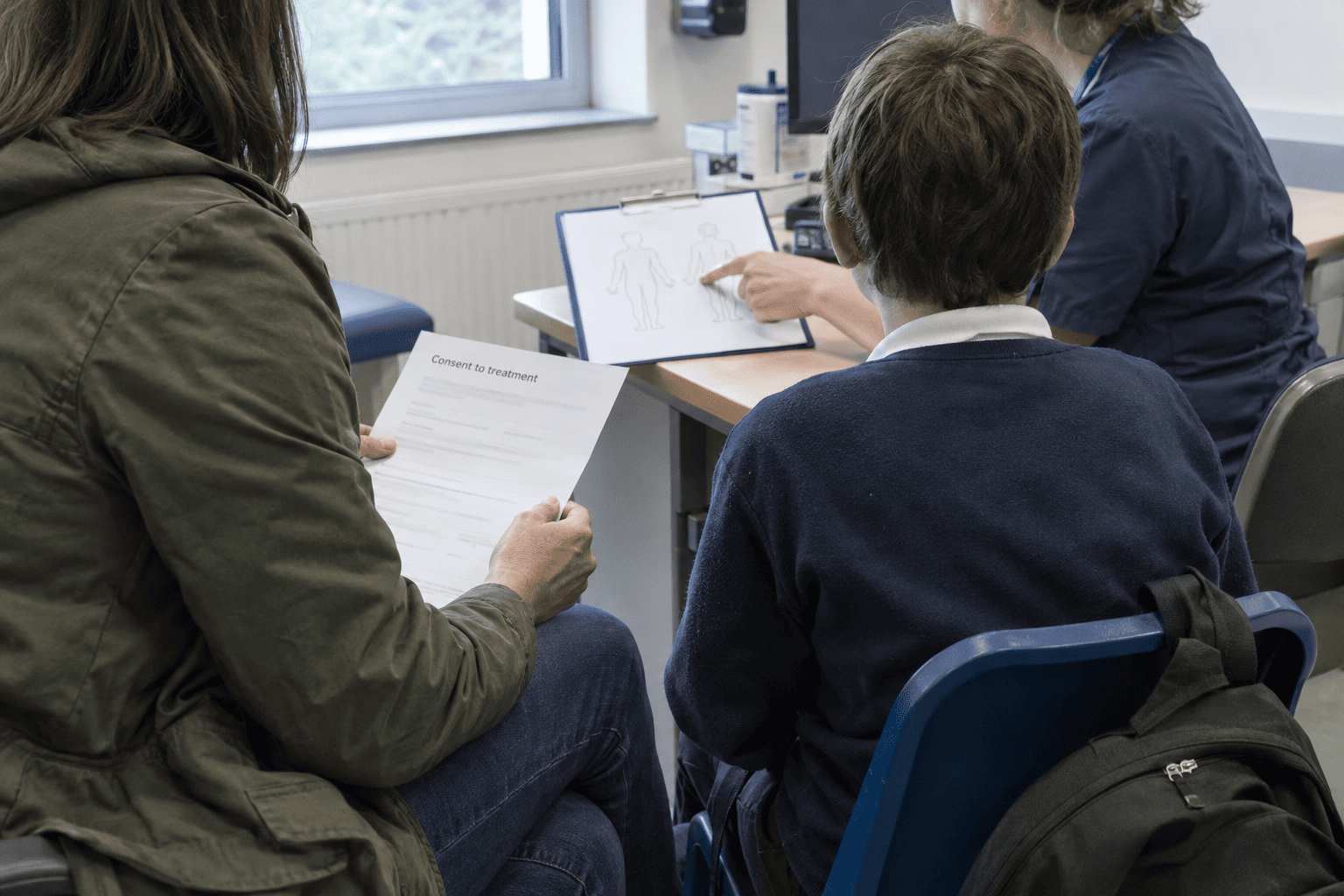
✓ consenting to medical treatment
✓ the child’s surname
✓ removal from the jurisdiction and consent to the child’s emigration or holidays
✓ applying for or vetoing the issue of a child’s passport
When making decisions, smaller decisions (such as personal care for children, activities undertaken and how the children spend their time with that parent) can be taken alone but bigger decisions, such as changing a child’s surname or taking them abroad for a holiday – or relocating with the child whether in England and Wales or outside, need everyone’s agreement. In the absence of agreement to such issues, an Order of the Court would be required.
Parental responsibility is separate from where your child lives day to day. You can hold full parental responsibility while your child lives mainly with the other parent, without losing your legal status as a decision-maker.
Who has parental responsibility?
You have parental responsibility automatically if you are your child’s mother, or if you are the father and were married to the mother at birth or are the biological father and registered on the birth certificate on or after 1st December 2003.
Every mother has parental responsibility automatically from the moment of birth and only loses it through adoption or a parental order made under the Human Fertilisation and Embryology Act 2008. A father who was married to the mother at the time of birth has parental responsibility automatically, regardless of when the birth was registered. An unmarried father gains it automatically only if he is registered as the father on the birth certificate on or after 1st December 2003.
The Court of Appeal clarified this route significantly in Re J (Loss of Parental Responsibility) [2026] EWCA Civ 344, one of three conjoined appeals reported together as Re J, Re M and Re P, handed down on 20th March 2026 by Sir Andrew McFarlane, President of the Family Division, sitting with Lady Justice King and Lord Justice Stuart-Smith. The court held that the word “father” in section 4 of the Children Act 1989 means the child’s biological father only, so a man mistakenly or wrongly registered on a birth certificate, who is not in fact the biological father, never acquires parental responsibility, regardless of how long he believed himself to be the father or how much of a parental role he has played.
A second female parent, recognised under section 43 of the Human Fertilisation and Embryology Act 2008, has parental responsibility automatically where she was in a civil partnership with the mother at the time of treatment, or entered one before the birth. If none of these automatic routes applies to you, you do not currently hold parental responsibility, but you are not without options.
How do I obtain parental responsibility?
If you do not already hold parental responsibility, you can gain it by agreement with the other parent (with a formal Parental Responsibility agreement), by re-registering the birth, or by applying to the Family Court for a Parental Responsibility Order.
Section 4 of the Children Act 1989 sets out three routes for an unmarried biological father: re-registering the birth to add his name to the certificate, entering into a parental responsibility agreement with the mother, or applying to the court for a parental responsibility order. A parental responsibility agreement must be made on the prescribed form, C(PRA1), and signed in the presence of a court official. Section 4ZA of the Children Act 1989 provides the equivalent agreement route for a second female parent, using form C(PRA3).
Where the other parent will not agree, you can apply to the Family Court using form C1, and the current court fee is £270.
Section 4A of the Children Act 1989 allows a step-parent to acquire parental responsibility in the same way, either by agreement with everyone who already holds it, or by court order, provided the step-parent is married to or in a civil partnership with a parent who has parental responsibility.
| Route | Who it applies to | What is required | Approximate cost |
|---|---|---|---|
| Automatic (mother) | All birth mothers | Nothing further is normally required | No cost |
| Automatic (married father) | Fathers married to the mother when the child is born | Nothing further is normally required | No cost |
| Birth registration | Unmarried biological fathers registered on or after 1 December 2003 | Registered on the birth certificate as the child’s biological father | No court fee |
| Parental responsibility agreement | Eligible unmarried fathers, second female parents and step-parents where the necessary agreement is obtained | Use Form C(PRA1) for a father, C(PRA2) for a step-parent or C(PRA3) for a second female parent; the agreement must be witnessed and registered | No court fee for the agreement; solicitor fees may apply |
| Parental responsibility order | An eligible applicant where agreement cannot be reached | Apply to the Family Court using Form C1 | £270 court fee; solicitor fees may apply |
Will the court say yes?
In Re H (Minors) (Local Authority: Parental Rights) (No 3) [1991] Fam 151, the Court of Appeal set out three factors relevant to an application for PR:
- the degree of commitment shown to the child,
- the degree of attachment between them, and
- the reasons for the application.
Lord Justice Balcombe, giving the leading judgment, held that these factors guide the court’s assessment under the welfare paramountcy principle rather than replacing it, and later cases have confirmed that a court can still refuse an order even where all three factors are met, for example where there is a history of violence or a clear intention to misuse the status to interfere with care arrangements.
Holding parental responsibility does not, by itself, give you a right to any particular amount of time with your child. Section 1(2B) of the Children Act 1989 states that a parent’s involvement in a child’s life can be direct or indirect and does not imply any particular division of a child’s time. Therefore, questions about contact and living arrangements are decided separately through a Child Arrangements Order.
Can parental responsibility be taken away?
Parental responsibility acquired through an agreement or a court order can be brought to an end by a further court order, but a mother’s automatic parental responsibility cannot be removed by another parent applying to court – only adoption ends this.
Section 4(2A) of the Children Act 1989 allows the court to end a parental responsibility agreement or order on the application of anyone with parental responsibility, or, with the court’s permission, the child themselves if they have sufficient understanding. The court will only remove parental responsibility in cases involving serious welfare concerns, since removing parental responsibility is a significant step. A mother’s automatic parental responsibility, and a father’s parental responsibility gained through marriage to the mother at birth, cannot be removed in this way; those forms of parental responsibility end only through adoption or death.
Please note this article does not constitute legal advice.
Talk to Purcell Solicitors
If you are unsure whether you already hold parental responsibility, want help reaching an agreement with the other parent, or need to apply to the Family Court, we can talk you through the right route for your situation. Contact us on 01908 693000 to discuss how we can assist.
Further reading:
For more information, please see below.
A Complete Guide To Children’s Law After Separation
What is a child arrangements order?
Frequently asked questions
Do I lose parental responsibility if I stop seeing my child?
No, parental responsibility does not lapse through lack of contact. If you hold it through an automatic route, an agreement, or a court order, it continues unless a court specifically brings it to an end or your child is adopted.
Can I apply for parental responsibility if the mother refuses to agree?
Yes, you can apply to the Family Court using form C1 for a parental responsibility order. There is a court fee (currently £270), and the court decides the application using the welfare checklist rather than requiring the other parent’s consent.
Does paying child maintenance give me parental responsibility?
No, paying child maintenance has no legal connection to parental responsibility. The two obligations are governed separately, and paying maintenance neither creates parental responsibility nor is required to keep it once you have it.

Director – SRA number: 494434
Lisa Buckridge is a Director at Purcell Solicitors and has over 20 years of experience in family law. She qualified in the early 2000s and became a director of the firm in October 2015. She holds accreditation as a Family Mediation Council-accredited Mediator, obtained in 2022, and is one of a small number of lawyer-mediators qualified to carry out Child Inclusive Mediation. She is also a trained collaborative lawyer and hybrid mediator.
Lisa handles the full range of family law matters, including divorce, financial settlements, children proceedings, pre- and post-nuptial agreements, and cohabitation disputes. Her referrals come principally from solicitors, including London-based practices, the local judiciary, and former clients, a pattern that reflects her standing in the field. She has worked on cases involving a terminal health diagnosis and cases in which the opposing party was a specialist family law barrister.
Chambers and Partners ranks Lisa in Band 3 for Family/Matrimonial in the Thames Valley in the UK Guide 2026. She has also been spotlighted specifically for her mediation practice in the Family/Matrimonial Mediators: Thames Valley category. Chambers describes her as “an excellent solicitor who robustly and effectively represents her clients’ interests” and as “incredibly clever” with the ability to “construct cases perfectly”.
Her reported cases include Re R (a child) EWCA Civ 35, in which the Court of Appeal held that a judge had erred by failing to properly evaluate a child’s wishes or to hear evidence from a CAFCASS officer before departing from that officer’s recommendation. She also acted in Scotching and Birch EWHC 844 (Ch), a case concerning burial arrangements and letters of administration following the death of a child; the case has since been cited in several academic papers and journal articles.
Lisa is a member of Resolution and is regulated by the Solicitors Regulation Authority (SRA number: 494434). She can be contacted at lisa@purcellsolicitors.co.uk.