Financial Remedies Reform Explained
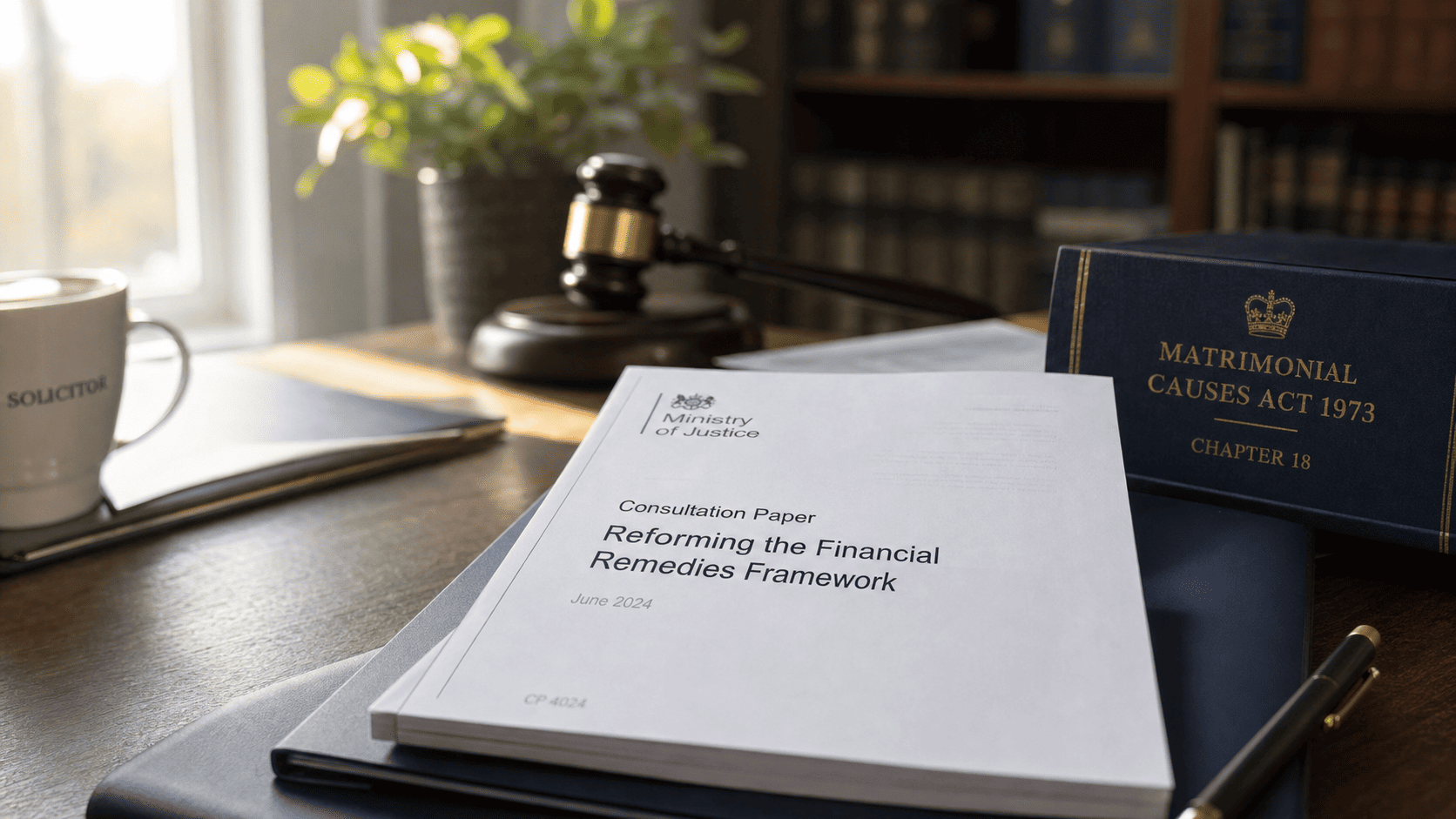
A new Government consultation, entitled A Fairer End to Relationships, proposes bringing settled case law into statute and introducing binding qualifying nuptial agreements. In England and Wales, the current law under section 25 of the Matrimonial Causes Act 1973 gives judges wide discretion, which the Law Commission’s December 2024 scoping report found creates uncertainty rather than settled expectations. Nothing changes for your case today since the consultation closes on 14th August 2026 and any resulting legislation is not expected before 2027 or 2028 at the earliest.
Last reviewed: 21st July 2026
Article summary
✓ The Law Commission concluded in December 2024 that the law lacks the certainty and accessibility that couples need when negotiating a divorce financial settlement.
✓ The government’s preferred model, called codification-plus, would set today’s case law principles into statute while making targeted changes in areas like nuptial agreements.
✓ If you want financial certainty now, a pre-nuptial or post-nuptial agreement, drafted properly, already carries significant weight under existing law.
✓ Non-court dispute resolution remains the fastest route to a settlement for you right now, whatever reforms eventually follow.
Introduction
The rules governing divorce financial settlements are currently well understood, however the Matrimonial Causes Act 1973 has not been substantively rewritten in over fifty years. Marriage and families have changed a great deal over this time. That’s why, on 5th June 2026 the government launched a consultation, A Fairer End to Relationships. If the proposals are passed into law, it would signify the biggest change to divorce finance law in England and Wales in decades.
At the centre of the proposals is a ‘codification-plus’ model, which would put settled case-law principles, such as sharing and needs, into statute for the first time, while keeping a degree of judicial discretion within a clearer framework. The consultation also asks whether legally binding ‘qualifying nuptial agreements’ should be introduced, giving couples more certainty over how their finances would be divided if they later divorced, provided safeguards such as full financial disclosure and independent legal advice are met.
None of the above impact your position if you are going through a divorce today. The consultation closes on 14th August 2026, and any reform will still need further policy development and a new Act of Parliament before it becomes law, so it will not affect cases already before the courts.
Why is the current law considered uncertain?
The current law gives judges very wide discretion under section 25 of the Matrimonial Causes Act 1973, and neither ‘financial needs’ nor ‘matrimonial property’ is defined anywhere in the statute itself. Two judges can reach different outcomes on similar facts, making it hard for you to predict your own case.
The
What is the Law Commission’s position?
The Law Commission concluded in its December 2024 scoping report that the law around divorce financial settlements requires reform but left the choice of model to government rather than making a specific recommendation itself. It set out four broad possible approaches, from a straightforward restatement of existing case law to a wholly new default matrimonial property regime. These ranged from:
✓ Codification – which restates current case law with minimal change.
✓ Codification-plus – which restates the law but makes targeted reforms in areas like nuptial agreements.
✓ Guided judicial discretion.
✓ A default regime – resembling frameworks used elsewhere in Europe.
The government has since chosen codification-plus as its preferred model, confirming its June 2026 consultation document would bring ‘settled case law principles, such as those of needs and sharing, into statutory form,’ according to the official consultation document.
What is proposed for nuptial agreements
The consultation proposes introducing binding qualifying nuptial agreements, which would let you and your partner make financial arrangements in advance that a court must uphold, subject to specific safeguards. This would go further than the current law, where nuptial agreements carry significant weight but are never fully binding on the court.
Under the current law, the Supreme Court held in Radmacher v Granatino [2010] UKSC 42, at paragraph 75, that:
“The court should give effect to a nuptial agreement that is freely entered into by each party with a full appreciation of its implications unless in the circumstances prevailing it would not be fair to hold the parties to their agreement.”
For you, that means a well-drafted agreement already carries real weight today, even though the court remains, in the Supreme Court’s words, ‘the arbiter of the financial arrangements between the parties.’ The government’s proposed qualifying nuptial agreements would remove much of that residual discretion in qualifying cases, provided you both entered into the agreement freely and with full disclosure.
What should you do right now
You should proceed with your financial settlement exactly as the current law requires, since no part of the consultation changes the rules that apply to your case today. If you want more certainty over your own arrangements, a properly drafted nuptial agreement already gives you that protection under existing law, without waiting for legislation that remains years away.
If you are considering marriage or are already married and want to protect specific assets, ask us about a pre-nuptial or post-nuptial agreement drafted to meet the Radmacher safeguards: entered into freely, with independent legal advice for both of you, and with full financial disclosure. If you are already separating, resolving your finances now under the current, well-established framework remains the right approach.
Talk to Purcell Solicitors
These reforms affect how financial settlements are approached across the board, so it is worth speaking to our divorce financial settlement solicitors about what the changes mean for your case. If you want to understand how the proposed reforms might affect your situation, or want a nuptial agreement drafted to the current legal safeguards, we can talk you through your options. Our family law team advises on financial settlements and nuptial agreements across Milton Keynes and the Thames Valley. You can reach us through our contact page or by phoning +44 (0) 1908 693000.
Last reviewed: 27th July 2026
Please note this article does not constitute legal advice.
Frequently Asked Questions
When will the proposed changes to divorce financial settlements take effect?
No date has been set. The consultation closes on 14th August 2026, and any resulting legislation is not expected before 2027 or 2028 at the earliest, since the government must first analyse responses and draft a bill before Parliament can consider it.
Does the consultation affect my divorce if it is already underway?
No, your case will be decided under the current law regardless of the consultation’s outcome since no legislative change has been made. The Matrimonial Causes Act 1973 and existing case law continue to apply to your settlement today.
Should I get a nuptial agreement now rather than waiting for reform?
Yes, a properly drafted nuptial agreement already carries significant weight under the current law following Radmacher v Granatino, so there is no benefit to waiting for qualifying nuptial agreements to become law before protecting your position.

Senior Family Law Partner & Director – SRA No. 258177
Pauline Purcell is the Managing Director and founder of Purcell Solicitors, a specialist family law firm based in Milton Keynes. She qualified as a solicitor and built her early career at Fennemores, a top-100 legal firm in central Milton Keynes, where she became a partner and head of the family department before establishing Purcell Solicitors in 2005.
She has specialised exclusively in family law for over 30 years. Her qualifications span several disciplines: she is a solicitor, a trained mediator, a collaborative lawyer, and a family arbitrator, and she was among the first collaborative lawyers in England. She holds a law degree from the University of Buckingham, where she also lectured on the part-time undergraduate law programme.
Chambers and Partners has ranked Pauline as a Band 1 practitioner for Family/Matrimonial in the Thames Valley for several years. The 2025 Chambers and Partners Guide describes her as “incredibly astute and excels at getting to the heart of the issue,” “robust and frighteningly clever,” and “a rock and massive support” to clients throughout their cases. She is also listed as a Leading Lawyer by Wiselaw.
Her particular expertise lies in high-value financial cases, including those involving business assets, pensions, and complex or international elements. She is a long-standing member of Resolution and is committed to reaching negotiated agreements wherever possible, though she regularly represents clients in court and family arbitration when proceedings become necessary.
Pauline is regulated by the Solicitors Regulation Authority (SRA number: 258177). She can be contacted at pauline@purcellsolicitors.co.uk.